Search
155 items
-

Baghchal, Pataleshwar (1)
The image shows both an incised or engraved board of Bagh Chal board along with a Mancala board. The mancala board lies on the left with the etched bagh chal on the right side of the image. Bagh Chal or Tigers and Goats is an ancient hunt game that has been popular in many regions of the world. The board of Bagh Chal is part of the alquerque family which traces its history to the Moors of Spain in their Libro de Los juegos (book of games) commissioned by Alfonso X in the 13th century. Although the rules were first found there, the history of alquerque goes further back to Egypt and to a name mentioned in the Kitab-al-Aghani (book of songs) as Kirkat or Al-Kirkat. Besides reference in literature similar game boards have been found both in practice amongst players in various communities as well as in archaeological sites. Bagh Chal has many variants, and is known by different names all over India, Nepal, Bhutan and other countries of South Asia. The structure of the board, the number of pieces and the variants in the rules may vary from place to place but the intention of winning remains the same. It is a two-player game where one individual represents the tiger and the other represents the goats. The number of tigers vary from one to even five in some games while the number of goats can be twenty or less or more depending on the structure of the board and the rules popular to the region. Pataleshwar cave complex are a small group of five excavations, developed into a cave temple dedicated to Pataleshwar, God of the underworld or Shiva. This cave complex is ruggedly excavated and also bears resemblance with the Elephanta caves of Mumbai. The cave has unfinished murals on the sides and on the backside. There is a Nandi pavilion at the entrance of the cave which is circular. The inside of the main cave contains a pillared hall with a pradakshinapatha the way to go around the shrine. One side of the cave remains unfinished. This and other boardgames were documented on the floor of the cave. These two boards were found on the right side of the pillared halls as mentioned in the cave plan. -
Tablan, Pataleshwar
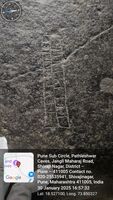
Tablan is a traditional Indian board game for two players, similar to Backgammon and Tâb, where the goal is to occupy more of your opponent's home squares than they do yours. [1, 2, 3, 4] Here's a more detailed breakdown: [1, 4, 5] Origin & History: Tablan is an ancient game originating in India, particularly in some villages in Mysore, southwestern India. [1, 4, 5] It could have originated from the Roman games Duodecima Scripta. This etched boardgame has been documented from Pataleshwar Cave in Pune. Pataleshwar caves are a small group of five excavations, developed into a cave temple dedicated to Pataleshwar, God of the underworld or Shiva. This cave complex is ruggedly excavated and also bears resemblance with the elephanta caves of Mumbai. The cave has unfinished murals on the sides and onthe backside. There is a Nandi pavilion at the entrace of the cave which is circular. The inside of the main cave contains a pillared hall with a pradakshinapatha the way to go around the shrine. One side of the cave remains unfinished. This and other boardgames were documted on the floor of the cave etched or excavated. This is a complete graffiti board situated on the last row of the right hand side of the cave facing the Linga. -

Aek-drupa
This is a throwing game where five pebbles need to be thrown and caught by the player in succession. In the video,Tshokey Lhamo and her friend from Radhi Gewog, Tashigang, demonstrate game called Aek-drupa with Pebbles. This game is also known to be common in India and Nepal as well. -
Atharagutiala Teora
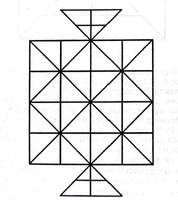
This game was recorded by Hem Chandra Das Gupta and the information was collected during one of his field visits to Gosalpur in the district of Jabalpur, in present Madhya Pradesh. He mentions in his essay that the play pattern of this game is similar to Bara-Guti which he documented in Bihar. The difference lies in the structure of the board. -
Atharah Guti (Eighteen Pieces)
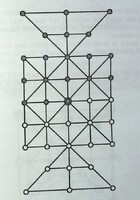
This game was documented by Humphries in The karvi subdivision of Uttar Pradesh. While it is called Ahtarah Guti in Uttar Pradesh it is also known as Bazi Mar, Ticcha or Bangala. This board also has similarities with other boards such as Mughal Pathan or other types of Alquerque boards like Atharagutiala Teora, Sipahi Kat, or Lam Pusri. It is a two-player game played on a space of thirty seven as shown in the image. Each of the two players have eighteen pieces to play the game. The game is played by captures and ends with one player capturing his opponents pieces or ‘men’ as Humphries calls them. -
Bagh Bandi
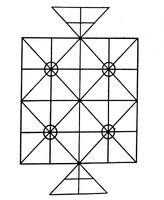
This game has been recorded by Jatindra Mohan Datta In Basirhat in the 1930s. The name of the informant was Santosh Kumar Ray who explained that he used to play this game in his childhood. According to Jatindra Mohan Datta, the board or the diagram of the game shown here has similarities with the Mughal-Pathan game. Bagh Bandi or Bagh Chal is played on a board by two players. Often, one players plays with four tigers, while the other has twenty goats. The tigers need to jump over and eat five goats whereas the goat needs to corner all the tigers to win. The game is the national game of Nepal and exists in multiple variations all over South Asia. In the variation reported by Datta, this game is played with two tigers and thirty-two goats. the goats are placed in a group of eight at points enclosed by circles in the diagram at the beginning of the game. The two tigers are placed or can be placed anywhere on the board. It is then followed by the usual rules of Bagh Chal or Bagh Bandi. In this form, two or more captures are allowed one after the other but not by jumping forward and then backward over the goats. -
Bagh Batti
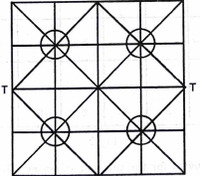
This game was documented at the region of Uttarkhand, which was once known as the British Garhwal by Hem Chandra Das Gupta during his geological fieldwork. The informants were inhabitants of the area. The game of bagh-batti (bagh or tiger and batti or piece) is a type of tigers and goats or bagh chal played by two people, one of whom is the possessor of two pieces representing two tigers and the other of twenty pieces or battis. There are many variants of Bagh Chal found all across India. It is a hunt game which is also popular in Nepal and sources also show a variant of Tagnor being played in Bhutan. It is an alquerque game and all the variants require two people to play. The differences lie in the structure of the boards and the number of pieces a tiger represents or goats. In this variant another important difference is that the goats are placed in stacks instead of one in each point which changes the way the game is played. The intention of winning remains similar to other forms of Tiger and Goat games. -
Bagh Chal
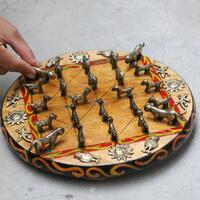
Bagh Chal is played on an alquerque board by two players. One has four tigers, while the other has twenty goats. The tigers need to jump over and eat five goats whereas the goat needs to corner all the tigers to win. The game is the national game of Nepal and exists in multiple variations all over South Asia. There are multiple variants of the game across South Asia.