Nine Men's Morris, Handmade
Item

- Title (dcterms:title)
- Nine Men's Morris, Handmade
- Description (dcterms:description)
-
Nine men's morris is a classic game of pure strategy. It has been described as "noughts and crosses for adults", as it shares the simpler game's aim for forming rows of three, but weaves that aim into a much more sophisticated game of wits. It is mentioned in Shakespeare's A Midsummer's Night's Dream where Titania says, 'The nine men's morris is filled up with mud' (Act 2 Scene 1: ll. 98-100). A similar game is also mentioned in Ovid's Ars Amatoria.
The rows of three, called "mills", are not the main aim of the game, they are a means to an end. The board starts empty, and players place their pieces in turn; forming a row of three allows the removal of an enemy piece. When all pieces are placed, they slide from one position to another, still trying to form mills and capture enemy pieces. The aim of the game is to reduce the opponent to two pieces, rendering them unable to form any more mills.
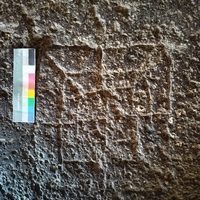
The game of nine mens morris is so ancient that we do not know its origin. From the stones of ancient Kurna in Egypt, to the stone- or bronze-age burial sites of Cr Bri Chualann, in County Wicklow in Ireland, the pattern for the board has been found in many ancient contexts.
This particular board is made of cotton with a batik print on it which is popular in Bengal. This board is made by Ramsons Kreera Pratisthan. They are working towards the revival of traditional Indian Boardgames through manufacture of handmade boards, casting pieces and counters. They collaborate with artists and artisans all across India to make such boardgames and their material have a number of varieties such as, Navalgund Jamkhana, Silk embroidery, Batik print, Mysore silk zari weaving etc. Other than variants in types of cloth and handloom they also manufacture boardgames on Marble, Mysore wood, Brass Casting, Wood Polychrome and many as such. - Alternative Title (dcterms:alternative)
-
Dahdi, Navakankari, Merrells, Navakankari, Muhle, Daadi,Saalu Mane Ata ,Char-Par, Navkakri, Mill
- Rules (dcterms:instructionalMethod)
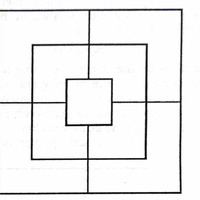
- Played on a board of three concentric squares, with a line bisecting the perimeters of each square on each side, but not extending inside the perimeter of the central square. Play occurs on the intersections of the lines and the corners of the squares. Each player has nine pieces. Play begins with each player placing pieces on empty points. If they make three in a row along the lines, they can remove one of the opponent's pieces. They cannot remove an opponent's piece that is in a three-in-a-row formation unless there are no other options. Once all pieces are placed, players take turns moving pieces one spot to an adjacent point along the lines. If a player makes three in a row, an opponent's piece is removed as in the first phase of the game. Once a player is reduced to three pieces, that player may move to any open space on the board. The game is won when the opponent is reduced to two pieces.
- Creator (dcterms:creator)
- Ramsons Kreera Pratisthan
- Contributor (dcterms:contributor)
- Souvik Mukherjee and Adrija Mukherjee
- Rights (dcterms:rights)
- Creative Commons
- Format (dcterms:format)
- Boardgame on Cloth
- Medium (dcterms:medium)
- Boardgame made of Cotton Cloth with a Batik print
- References (dcterms:references)
- Nine Men's Morris- Cyningstan
- Murray, H.J.R. A History of Board Games other than Chess. Oxford University Press, 1952.
- Nine Men's Morris- Digital Ludemi Project
- Spatial Coverage (dcterms:spatial)
- Mysore, Karnataka
- Variants (dcterms:isVersionOf)
-
 Nau Bhar
-
 Nao Guti
-
 Nine Men's Morris: Downloadable Game
-
 Tule Paid
-
 Tuk-Tak
-
 Nine Men's Morris, Handmade
-
 Sujjua
-
 Nine Men's Morris Kailash Temple, Ellora (2)
-
 Nine Men's Morris/ Dahdi, Ellora
-
 Nine Men's Morris
- Entered by (dcterms:accrualMethod)
- Adrija Mukherjee
- Notes (foaf:status)
- This board is on display at the Centre for Studies in Social Sciences, Calcutta
- Tags (dcterms:conformsTo)
- Nine Men's Morris
- Dahdi
- Ramsons
- Mysore
- Two-player
- Games of Alignment
- Cloth
- Batik
- Media
- Nine mens morris.jpg