Kolokpa
Item
- Title (dcterms:title)
- Kolokpa
- Description (dcterms:description)
-
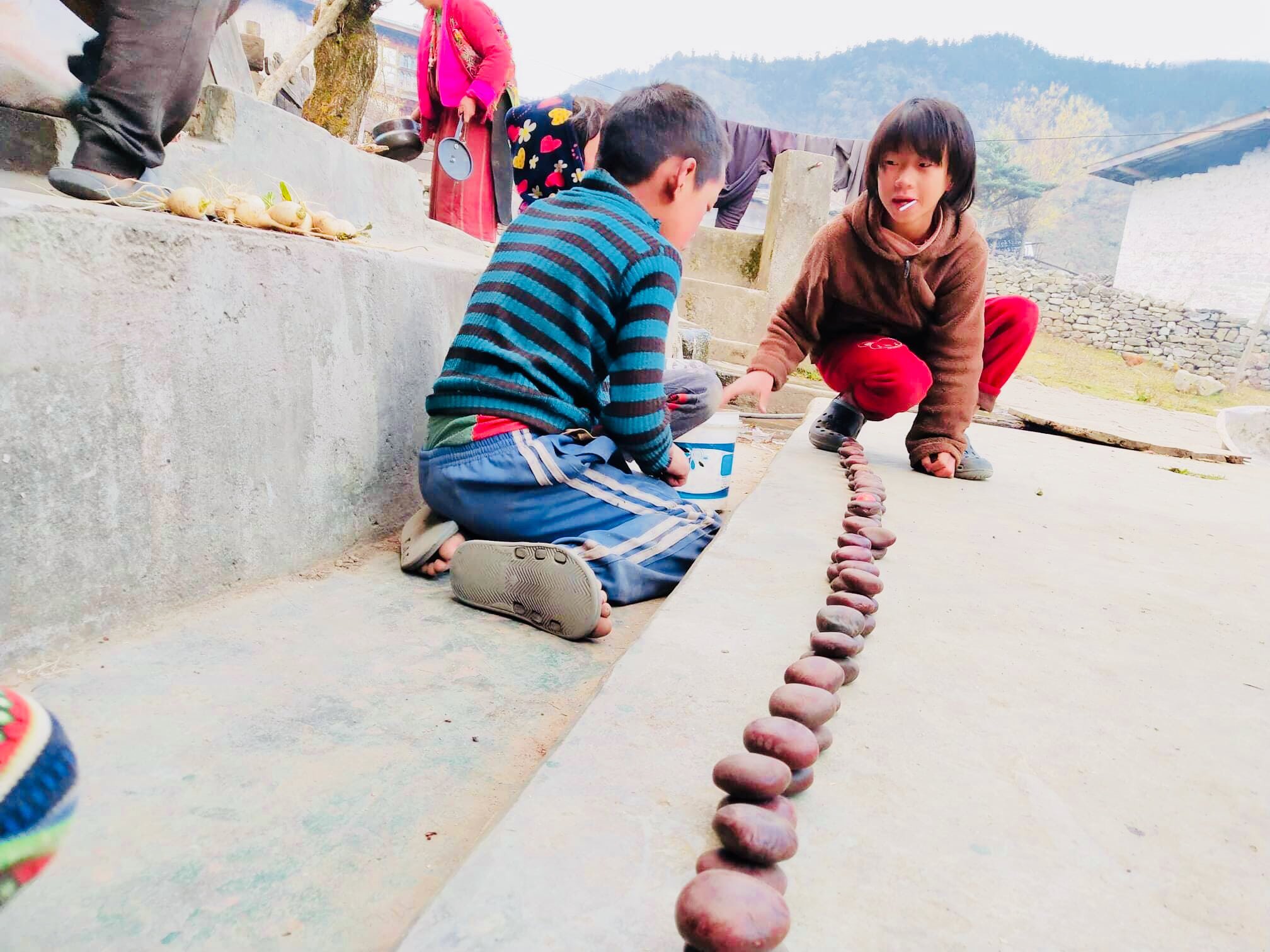
Kolokpa (ཀོ་ལོག་པ) is a game long played by Bhutanese, amongst cow herders to pass their time while their animals graze. Kolokpa refers to the dry round seed extracted from the pod of a wild creeping plant (African dream herb Entada rheedii); these are collected and used to play the game, thus giving it its name. It is an indigenous game passed on from generation to generation through its play practices and according to sources, the game is also played in the winter seasons as it is the end of fruitful tiring journey of the year of cultivation to the villagers and people do not have other activities on their fields. It is even played by lay monks (gomchen) to pass their free time in the intervals between festival rituals.
This game can be played by any number of people (more than two) but it can only be played in even numbers like, two, four, six, eight and ten. There is also betting or gambling involved in the game.
The Kolokpa game requires a number of dry round seeds, enough to constitute a stack. The number of stacked kolokpa seeds depends on the players; the larger the stack, the longer the game. Each player or team puts their stack of seeds on the ground in a straight line.
The game begins by spinning a kolokpa seed on the ground, with the aim of hitting and disrupting the other team’s stack of seeds. The distance between the kolokpa seed and its target is usually between three and four meters. The spinning kolokpa must touch or hit as many of the opponent’s seeds as possible. Any of the opponent’s seeds that are disrupted or moved are taken by the shooter and added to his stack. The one who has the most seeds at the end is the winner.
A Kolokpa seed can also be used in musical instrument today as a yangkali, which can produce amazing rhythm sounds by vigorously shaking the pod. Once dried, the seeds have a hard shell.
Kolok-pa game does not differentiate between gender and age of the player, but teams are selected usually depending on the gender. According to 65 years old Meme Ugyen Guru, the game in the past can be played by burning bamboos and pinewoods for lighting the ground in the evenings. Mostly the betting is done for winning Bangchang, Ara (Local wine), pork and other food and drinks. The winner of the match is declared based on mutual understanding made within the players, and the bet is to be paid either after every game or out of three sets.
- Alternative Title (dcterms:alternative)
- Inkawibah - Mizoram, Tholi/Khuling Khudaba/Apukhu Kupusu – Nagaland
- Rules (dcterms:instructionalMethod)
-
Proceedings, Steps and rule of Kolok-pa
• Teams to be formed.
• The team is made upon the division of the Kolok-pa bai (Mother striker) by non-players upon closing his or her eyes.
• The one who divides the mother striker (Kolok-pa bai) need to close eyes to avoid the bias in division as some players might be experts or star strikers.
• The Kolok-pa (element) is stack in two-piece and stacking pairs in rows are count as chi-ni, then count as Sum-zhi, Nga-druk Dhuen-gay and Gu-say till reached in Mung-du (Mung-du is either mark with digging small hole or by marking with marble) again after that will count same.
• The stacking can be made in line and its term as Wung-thur (Wung means ground and thur means one) meaning it occupy one ground or its worth occupying one ground.
• The team will mark the starting line to spin and dive mother striker (Kolok-pa bai) to strike the erection made in line. However, the length between starting line and erection of Kolok-pa may differ based on the space of the ground.
• If the striker strikes one piece the team will collect two-piece, collection is double the striking made.
• After completion of all players diving the mother striker towards the erected Kolok-pa which are lined up, the players have to measure the length of mother striker from center mark (Mung-du) whoever’s mother striker is far from the center mark, the player will dive first from the landed position which they have spin or dived from the starting line. The measurement is done by using stick or ropes.
• The team will re-erect as per the team who has collected minimum pieces/numbers of pairs
• The game will end only, when all the pieces are being collected by the one team.
- Creator (dcterms:creator)
-
Mr. Pema Choizang, Teacher, Tsebar Lower Secondary School, Pemagatshel.
Sonam Chophel
Researcher at Shejun Agency for Bhutan’s Cultural Documentation and Research. - Source (dcterms:source)
-
Thongsa community, Chongshing Gewog (block), Pemagatshel, Mr. Pema Choizang, Teacher, Tsebar Lower Secondary School, Pemagatshel and Sonam Chophel,
Researcher at Shejun Agency for Bhutan’s Cultural Documentation and Research.
-
NATIONAL INSTITUTE OF PUBLIC COOPERATION AND CHILD DEVELOPMENT
https://www.nipccd.nic.in/uploads/pdf/gamesnplaypdf-4b0a786e2ec8f3e229261f0418679cc3.pdf - Contributor (dcterms:contributor)
- Mr. Pema Choizang, Teacher, Tsebar Lower Secondary School, Pemagatshel and Sonam Chophel, Researcher at Shejun Agency for Bhutan’s Cultural Documentation and Research.
- Rights (dcterms:rights)
- Creative Commons
- Format (dcterms:format)
- Boardgames
- References (dcterms:references)
- Kolok-pa (An Indigenous Game)
- Kolokpa: A Game of Skill and Strategy Bhutan
- Games and Play- Kolokpa
- Spatial Coverage (dcterms:spatial)
- Bhutan
- Arunachal Pradesh
- Entered by (dcterms:accrualMethod)
- Adrija Mukherjee