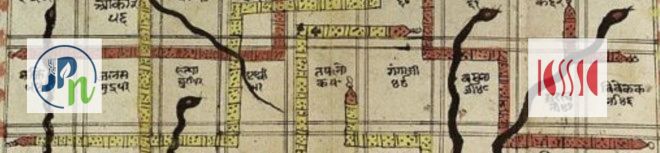
Chonpa- A Variant of Pachisi
Item

- Title (dcterms:title)
- Chonpa- A Variant of Pachisi
- Description (dcterms:description)
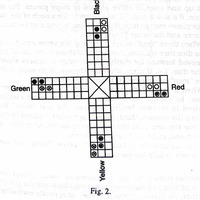
- This variant of Pachisi has been recorded by by E. De. M. Humphries in Karwi, a district in Uttar Pradesh. It is known as Chonpa or Chaunsarh. According to Humphries, Another variant is known as “Chonpa” or “Chaunsarh.” It is a four player game, each having four “men,” coloured respectively black, yellow, green and red as shown in the image. The two former play in partnership against the two latter colours. The board is the same as a Pachisi board with the exception that the safe squares mentioned in the case of pachisi are either not marked at all or are disregarded, if the board is one made for both games. A single piece may, and a pair may not, be captured on any square to which a hostile piece may be moved. The moves are regulated by throwing three dice: not, as in the case of Pachisi, —cowries. These dice as documented were of bone or ivory and are about 2% inches long, marked on their long sides with the numbers (1), (2), (5) and (6).
- Alternative Title (dcterms:alternative)
- Pachisi, Chaupar, Pagaday
- Rules (dcterms:instructionalMethod)
- Four 3x8 rectangles, arranged in a cross. No marked squares. Four players, each with four pieces, which are black, yellow, green, and red. Yellow seated at the bottom, red to their right, black to the right of red, green to the right of black. Green and red play on a team against black and yellow. Three four-sided rectangular dice, each marked 1, 2, 5, and 6. Pieces begin on the board, with one each in the sixth and seventh space of the central row of the player's arm, (counting from the top of the row), and in the seventh and eighth spaces of the left row of the arm belonging to the player to the right. The latter two pieces must move as a pair, I.e., they must always be moved together, and can only do so when doubles are thrown. The other two pieces belonging to a player may move singly. Throws may be split up as a player sees fit, but the value of one die must be used it its entirety by a piece. Pieces move around the board in an anti-clockwise direction until they reach their central row, at which point they move up the central row to the central spot. They must enter the central space by an exact throw. When a player moves all of their pieces to the center, they continue to throw the dice, and use these throws to move their partner's pieces. When all of the team's pieces reach the center, that team wins.
- Creator (dcterms:creator)
-
E. De. M. Humphries
- Source (dcterms:source)
- NOTES ON "PACHESI" & SIMILAR GAMES by E. De. M. Humphries in Sedentary Games of India eds. Nirbed Ray and Amitabha Ghosh
- Contributor (dcterms:contributor)
-
E. De. M. Humphries
- Rights (dcterms:rights)
- Creative Commons
- Format (dcterms:format)
- Boardgames
- Medium (dcterms:medium)
- Boardgames on Text
- References (dcterms:references)
- NOTES ON "PACHESI" & SIMILAR GAMES by E. De. M. Humphries in Sedentary Games of India
- Chonpa- Digital Ludemi Project
- Spatial Coverage (dcterms:spatial)
- Uttar Pradesh
- Variants (dcterms:isVersionOf)
-
1. T'shu-p'u is a small version of Chonpa or Pachisi from China also known as Chatush-pada in India.
2. Chaupar is another variant of Pachisi, also originated in India.
3. Parcheesi, originally called Patcheesi, is an American copyrighted variation of Pachisi.
4. Parchís Is a variant from Spain
5. Puchese was possibly an early Pachisi variant from England.
6. Mensch ärgere dich nicht is a German Pachisi variant developed by Josef Friedrich Schmidt in 1907/1908 and first marketed in 1914. -
 Chonpa- A Variant of Pachisi
-
 Pachisi
-
 Chaupar: Downloadable Game
-
 Chaupar, Handmade
-
 Chaupar, Pataleshwar (Incomplete)
-
 Mancala, Pataleshawar (8)
-
 Chaupar, Pataleshwar (3)
-
 Chaupar, Pataleshwar (2)
-
 Chaupar, Pataleshwar (1)
- Entered by (dcterms:accrualMethod)
- Adrija Mukherjee
- Notes (foaf:status)
-
A civil servant who was appointed as the Sub-divisicnal Officer at Karwi Sub-division at IJ.P. in 1904 Submitted an inspection report on Mauza Gidarah, Pargana Karwi, the extract of which was published in the Journal of the Asiatic Society.
The essay mentions the United Province which was the term used for the region of Uttar Pradesh during the British Period.
- Media
- Chonpa