Nao Guti
Item

- Title (dcterms:title)
- Nao Guti
- Description (dcterms:description)
-
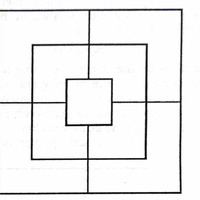
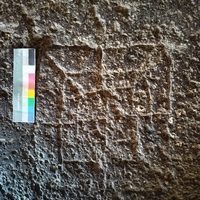
This game was documented by Hem Chandra Das Gupta while he was working on some of his own geological field work. The informants as he stated were Pathan or Pashtun who lived in Mianwali district of Punjab. He explained in his essay that the games he documented from the region were played by everyone in the area including both children and elders, and the games were found at times etched on stone slabs in common spaces. Similar looking boards have been commonly found both in incised patterns in various sites across India inside temples and also in other places. Nao Guti as the name suggests are played with nine pieces each and it is a two player game. Das Gupta draws comparison of this game with two other games that were documented in Eastern Bengal (now Bangladesh) in Bikrampur. They are known as bara-guti pait-pait, and tin-guti-pait-pait. The rules of the game are the same, but the diagrams used are different, though the difference between the patterns of the board used for nao-guti and baraguti-pait-pait is slightly different, that for the latter being only a little more elaborate and consistent with the increase in the number of pieces required for the game.
This type of alquerque board is also commonly found in other countries besides India, for example Achi from Africa, Triodi from Greece and many more. While the variant differs along with the number of pieces used by per player in the game but the structure of the board has its similarities.
- Alternative Title (dcterms:alternative)
- Nine Men's Morris, Navakankari, Saalu Mane Ata, Navkakri, Dahdi
- Rules (dcterms:instructionalMethod)
-
In the game of nao-guti (nine pieces), each of the two players plays with nine pieces and alternately puts one of his pieces on the ‘cross-points’, aiming to get three pieces along one line, while preventing his opponent from doing so.
Whenever a player succeeds in getting three of his own pieces in one line he captures one of the pieces belonging to his opponent.
After all the pieces have been put on the ‘cross-points’, the players begin to move their pieces alternately and along the lines as shown in the image. The player who captures all the pieces of his adversary is the winner.
- Creator (dcterms:creator)
- Hem Chandra Das Gupta
- Source (dcterms:source)
- ‘Few Types of Sedentary Games Prevalent In The Punjab’ by Hem Chandra Das Gupta in Sedentary Games of India eds. Nirbed Ray and Amitabha Ghosh
- Contributor (dcterms:contributor)
- Hem Chandra Das Gupta
- Rights (dcterms:rights)
- Creative Commons
- Format (dcterms:format)
- Boardgames
- Medium (dcterms:medium)
- Boardgames on text
- References (dcterms:references)
- Nao Guti- Digital Ludemi Project
- ‘Few Types of Sedentary Games Prevalent In The Punjab’ by Hem Chandra Das Gupta in Sedentary Games of India
- Spatial Coverage (dcterms:spatial)
- Punjab (currently Pakistan)
- Variants (dcterms:isVersionOf)
-
 Nao Guti
-
 Nine Men's Morris: Downloadable Game
-
 Tule Paid
-
 Nine Men's Morris, Handmade
-
 Sujjua
-
 Nine Men's Morris Kailash Temple, Ellora (2)
-
 Nine Men's Morris/ Dahdi, Ellora
-
 Nine Men's Morris
- Entered by (dcterms:accrualMethod)
- Adrija Mukherjee
- Notes (foaf:status)
- This essay was written before the independence period and after the partition the region of Mianwali now falls under Pakistan.
- Tags (dcterms:conformsTo)
- Nao Guti
- Nine Men's Morris
- Sedentary Games
- Punjab, Pakistan
- Two-player
- Movement
- Games of Alignment
- Guti
- Media
- Nao Guti.png