Khutki Boia
Item
- Title (dcterms:title)
- Khutki Boia
- Description (dcterms:description)
-
This game was documented by Hem Chandra Das Gupta while he was working on some of his own geological field work. The informants as he stated were Pathan or Pashtun who lived in Mianwali district of Punjab. He explained in his essay that the games he documented from the region were played by everyone in the area including both children and elders, and the games were found at times etched on stone slabs in common spaces. Similar looking boards have been commonly found both in incised patterns in various sites across India inside temples and also in other places.
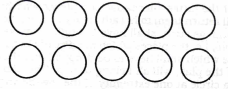
Khutki Boia is a two-player game. Two rows of five circles are required, each row belonging to one player. According to Das Gupta Khutki Boia literally meant dug circles thus five holes are either dug on the ground or scooped out in slabs of stone i.e. etched or inscribed. At the beginning of the game five pieces are placed in each hole so that each player requires 25 pieces. The rules that are followed are generally like those already described in connection with Mawkar-katya and a few other similar games, the pieces being moved from left to right. - Alternative Title (dcterms:alternative)
- Mow korkatia / Longbeuacha (Assamese ), Sat-gol (Hindi), Ali Guli Mane (Kannada), Vai Lung Thlan (Mizo), Kanji guti (Odia), Khutka boia (Punjabi ), Pallanguzhi/ Pallankuli (Tamil), Vamana Guntalu (Telugu), Chenna Maaney (Tulu), Pachgarhwa (Urdu), Til-goti, Chal goti (Mundari), Sat Gharoa (Bihar), Bakri (Chattisgarh)
- Rules (dcterms:instructionalMethod)
- 2x5 board. Five counters in each hole. Players take turns sowing in an anti-clockwise direction. When the final counter lands in a hole, the player picks up the contents of the next hole following this one, and continues sowing. If the player cannot pick up any counters from this hole, the players captures any counters from the hole after the empty hole, and the turn ends. At the end of each game the players may have the same number of pieces or one of them may have pieces in excess of those obtained by the other. The difference between the number of pieces belonging to the two players may be less than five, or more than five. If it is more than five, then all multiples of five belong to the winner and the corresponding number of circles belonging to the other player will be supposed to be non-existent and no pieces are to be thrown in them. When the difference is less than five, or when the number of pieces belonging to the winner is in excess of a multiple of five the sum of the excess pieces which are with the two players will be five, and these excess pieces may be distributed either in such a way that one player will have four pieces and the other only one or one player will have three pieces and the other only two. In case of the former alternative, the player with four pieces of stone will be styled the Bhadar, while the other one will be called the Kungidar and in course of the play the Kungidar will receive one piece at the commencement of each deal whether it is started by him or by his adversary; in case of the latter alternative the player who has got two pieces will return them to his adversary who will be styled the Bhadar and, as such, shall have the right to make one of his circles bhadar., i.e. the pieces which are already in that circle as also those which shall have to be dropped into that circle, in course of the play, will all belong to him. The bha, however, must be a circle at one extremity of the row-belonging to the Bhadar, i.e., the player who has three pieces in excess of a multiple of five. At the end of the play the Bhadar shall have to return to his adversary the two pieces obtained from him at the beginning of the play. The player who has the greater number of pieces with him without any restriction as to the time or the number of games is considered the winner.
- Creator (dcterms:creator)
- Hem Chandra Das Gupta
- Source (dcterms:source)
- ‘Few Types of Sedentary Games Prevalent In The Punjab’ by Hem Chandra Das Gupta in Sedentary Games of India eds. Nirbed Ray and Amitabha Ghosh
- Contributor (dcterms:contributor)
- Hem Chandra Das Gupta
- Rights (dcterms:rights)
- Creative Commons
- Format (dcterms:format)
- Boardgames
- Medium (dcterms:medium)
- Boardgames on Text
- References (dcterms:references)
- Khutki Boia - Digital Ludemi Project
- ‘Few Types of Sedentary Games Prevalent In The Punjab’ by Hem Chandra Das Gupta in Sedentary Games of India
- Spatial Coverage (dcterms:spatial)
- Punjab (currently Pakistan)
- Variants (dcterms:isVersionOf)
-
 Sat Gol Game
-
 Gud Phale
-
 Pachgharwa (five spaces/homes)
-
 Düzalé
-
 Kasadi
-
 Interview with Professor Priya Sangameswaran (CSSSC): On Playing Pallanguzhi/Pallangudi in Palakkad
-
 Rules of Pallankuzhi
-
 Sat- Gharoa
-
 Mawkar Katiya
- Entered by (dcterms:accrualMethod)
- Adrija Mukherjee
- Notes (foaf:status)
-
This essay was written before the independence period and after the partition the region of Mianwali now falls under Pakistan.
Also Note: The spelling of the title of this game is given as Khutki Boia by Hem Chandra das Gupta but in the Ludii reference it is Khutka Boia. - Tags (dcterms:conformsTo)
- Mancala
- Pallankuzhi
- Sedentary Games
- Punjab, Pakistan
- Two-player
- Cowrie
- Tamarind
- ten-hole
