Gyan Chaupar board (Jain version), Lokapurush motif
Item
- Title (dcterms:title)
- Gyan Chaupar board (Jain version), Lokapurush motif
- Description (dcterms:description)
-
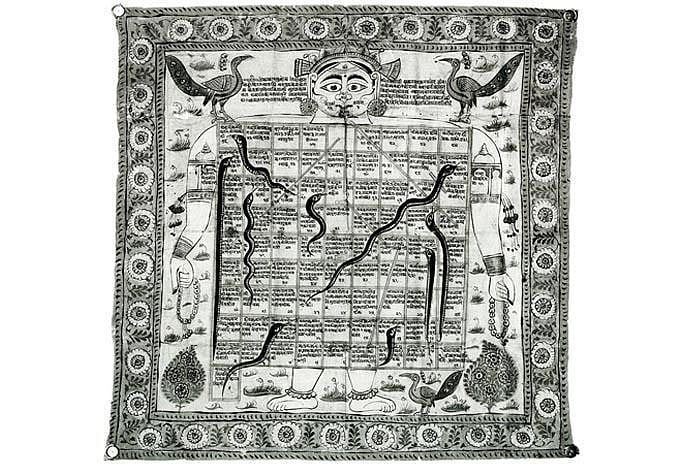
Calico Museum, Ahmedabad, acc. no. 98422 (fig. 4). Executed by Pandit Tej Vijaya Ganin (?) and dated Phalgun V. S. I 890/I 8 34 A. D. A boldly painted and attractive board of the lokapurusa type, with a background of peacocks, stylised plants and trees, within a floral border in orange, ochre, pink and olive green.
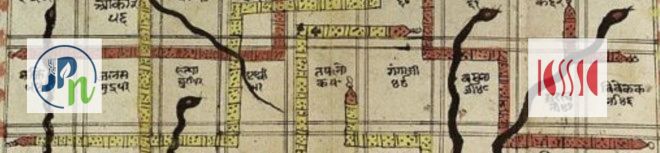
The gyan chaupar board used by the Jains of western India in the 18th and 19th centuries has 84 numbered squares, comprising a 9 x 9 square grid with three extra squares (I, 5 6, 66) at bottom left and at either side. Several additional squares (with separate numbering) generally appear above the main playing area, often enclosed within an architectural structure resembling a palace or temple (nos. II, I2, I5, I8). These squares are named Vijaya, Vaijayanta, Jayanta and Aparajita, with Sarvarthasiddha above them, and represent the vimanas of the Pancanuttara heaven, the highest of the heavenly regions according to Jain cosmology.15 Higher still is the crescent shape of Isatpragbhara (called Siddhasild or Muktiksetra on the boards themselves), the umbrella-shaped region at the topmost point of the universe, the abode of perfected souls who enjoy the eternal bliss of liberation.16 In the other principal variety of the Jain game, the playing area forms the body of the lokapurusa or Cosmic Man, whose head, arms and feet protrude from its sides (nos. IO, I4). The face of the lokapurusa and the crescent on his forehead again represent the Pancanuttara heaven and Tsatprdgbhdra.17 In keeping with the Jain passion for cosmological classification and theorising about the laws of karma, the nomenclature of the squares through which the player progresses is more systematic and detailed than in the Hindu forms of the game. There is some variation in nomenclature: whereas board no. IO, dated I834, uses long descriptive cap- tions for the squares, these are often abbreviated and simplified in later igth century boards. Some names, especially of spiritual vices, are shared with the Hindu game, e. g. krodha and the long snakes of tamas-ahankara (square 67 in nos. 13 and I 5) and rajas-ahan- kdra (leading from 75 to 2 in no. IO, much like the ahankara to maya snake in the 72-square Vaisnava board). The snakes in general represent the spiritual defilements which hinder the soul in its long upward journey from the various hells or the condition of the nigodas, the very lowest form of life, to the heavens and ultimate liberation. In no. I 5, for example, the snake squares include maithuna-saivyd (lust, 13); mithjydtva gunasthdna (17, "lack of insight", the lowest of the I4 gunasthdnas or stages of purification);18 lesyd nila (74, "blue lesya", the second darkest or most defiled of the "shades" of the soul); krsna lesya (75, "black lesya", the darkest of all); while the final snake (76) is mohanfya-karma, the residual karmas which cause the soul to become confused and desirous.19 In Jain doctrine, such karmic impediments must be dealt with by upasama ("suppression": ladder squares 7 and 44) or ksaya ("obliteration": ladder square 47). - Creator (dcterms:creator)
- Pandit Tej Vijaya Ganin
- Format (dcterms:format)
- Boardgame
- Medium (dcterms:medium)
- Cloth
- References (dcterms:references)
-
Topsfield, Andrew. 1985. “The Indian Game of Snakes and Ladders.” Artibus Asiae 46 (3): 203–26. https://doi.org/10.2307/3250203.
- Temporal Coverage (dcterms:temporal)
- I 8 34
- Spatial Coverage (dcterms:spatial)
- Ahmedabad
- Variants (dcterms:isVersionOf)
-
 Tibetan Game of Rebirth and Liberation (Sa lam rnam bzhag)
-
 Golok Dham
-
 Gyan Chaupar board (Jain version), Lokapurush motif
-
 Gyan Chaupar board (Jain Version)
- Date (dcterms:date)
- 30 March 2025
- Entered by (dcterms:accrualMethod)
- Souvik Mukherjee
- Approximate time period (dcterms:valid)
- 1834