Lam Turki
Item
- Title (dcterms:title)
- Lam Turki
- Description (dcterms:description)
-
This game was documented by Sunder Lal Hora at Kalijhora at present Kalimpong district. The informant of these games was a local man of the area who was of Nepali origin. Credit also has been given to Mr. F.D Raj of Kalimpong who helped confirm the rules and the descriptions of the documented games.
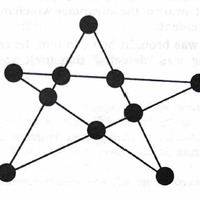
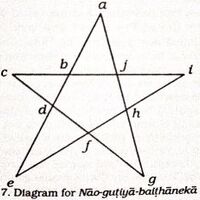
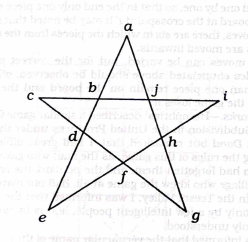
The game is played by one person, so it is a kind of a ‘Solitaire’, but usually a group of people sit together and play the game in turn. It is played on a board of ten cross points arranged as shown in the image. There are nine pieces with which the game is played. The actual play consists of two phases. In the first phase, the person playing has to get all his nine pieces on the board, and then in the second phase, by the usual method of jumping over, has to capture all except one. The pieces can be placed on the board in any way, except that when a piece is placed on a cross point or at a point it cannot be moved elsewhere.
When removing the pieces from the board, they are taken as in draughts by leaping over the piece to be captured to a vacant space in the same straight line. While placing the pieces on the board, the starting should be from any corner point.
Hora also mentions that a similar game has been documented by Humphries called Kowwa Dand in Uttar Pradesh. But the rules of the game were not clear according to Humphries. In the Teesta Valley at that time, Hora described that the game was only played by selective people owing to its difficulty.
He also mentions that 'Lam Turki' means going straight according to the informants which could refer to the characteristics of the movement of the game.
- Alternative Title (dcterms:alternative)
- Kowwa Dand
- Rules (dcterms:instructionalMethod)
-
The board is a five-pointed star. The player has nine pieces. In the first phase, the player attempts to place all the pieces on the board. The player choses a point, then moves the piece two spaces in a straight line. The piece may move through a spot occupied by another piece, but must land on an empty space. Once all of the pieces are placed in this way, the player captures a piece on the board by hopping over with with another one of the pieces to an empty space on the opposite side of the piece to be captured. The goal is to capture all of the pieces except one.
- Creator (dcterms:creator)
- Sunder Lal Hora
- Source (dcterms:source)
- ‘Sedentary Games of India’ by Sunder Lal Hora in Sedentary Games of India eds. Nirbed Ray and Amitabha Ghosh
- Contributor (dcterms:contributor)
- Sunder Lal Hora
- Rights (dcterms:rights)
- Creative Commons
- Format (dcterms:format)
- Boardgames
- Medium (dcterms:medium)
- Boardgames on Text
- References (dcterms:references)
- ‘Sedentary Games of India’ by Sunder Lal Hora in Sedentary Games of India
- Lam Turki- Digital Ludemi Project
- Spatial Coverage (dcterms:spatial)
- West Bengal
- Entered by (dcterms:accrualMethod)
- Adrija Mukherjee