Nau Bhar
Item
- Title (dcterms:title)
- Nau Bhar
- Description (dcterms:description)
-
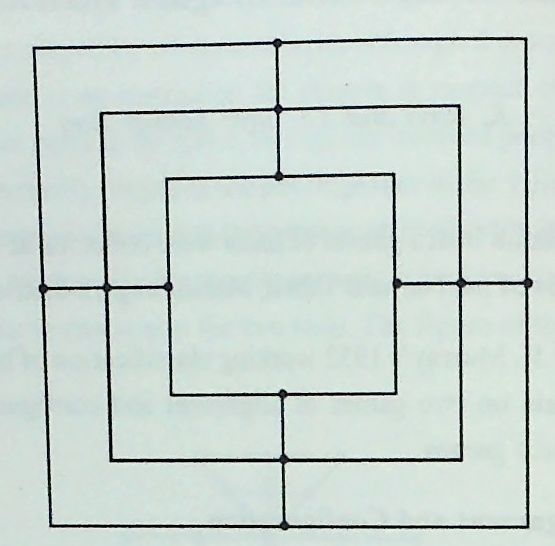
This board game can be reported as being played in the villages of the Mahendragarh district of Haryana, an area which is predominantly inhabited by the Ahir community. The game is invariably played by children and by the male members of any caste or community in the region. The game is locally called Nau bhar which means a game, played with nine pieces, such as pebbles or pieces of stone. Two individuals can play this game.
The board is usually drawn with a piece of charcoal, brick or chalk on a floor. The two players sit facing each other in front of the board. A set of nine pebbles or stone pieces of one colour is used by each player. Either player can initiate the game, or the pieces are placed alternately on the dots marked on the drawn lines that make up the board. The players attempt to place their pieces in such a way that three pebbles of one colour form a row or straight line (bhar). Taking alternate turns, the players can move one step in any direction, vertically or horizontally along the lines, from marked dot to marked dot. At the same time the players also make attempts to restrict each other's movements by placing pieces in between those of their opponent. Each row (bhar) entitles a player to remove one of his opponent's pieces. The winner either blocks all the opponent's pieces so that they cannot be moved, or reduces his opponent's number so that he is unable to form a row of three. - Alternative Title (dcterms:alternative)
- Bara Bhar
- Rules (dcterms:instructionalMethod)
- The two players sit facing each other in front of the board. A set of nine pebbles or stone pieces of one colour is used by each player. Either player can initiate the game, or the pieces are placed alternately on the dots marked on the drawn lines that make up the board. The players attempt to place their pieces in such a way that three pebbles of one colour form a row or straight line (bhar). Taking alternate turns, the players can move one step in any direction, vertically or horizontally along the lines, from marked dot to marked dot. At the same time the players also make attempts to restrict each other's movements by placing pieces in between those of their opponent. Each row (bhar) entitles a player to remove one of his opponent's pieces. The winner either blocks all the opponent's pieces so that they cannot be moved, or reduces his opponent's number so that he is unable to form a row of three.
- Source (dcterms:source)
- Indian Boardgame Survey by R.K. Bhattacharya, Irving Finkel, L.N Soni
- Contributor (dcterms:contributor)
- K Ravi and J S Jayasankar Rao
- Rights (dcterms:rights)
- Anthropological Survey of India
- Format (dcterms:format)
- Boardgames
- Spatial Coverage (dcterms:spatial)
- Mahendragarh District, Haryana
- Variants (dcterms:isVersionOf)
-
 Nao Guti
-
 Nine Men's Morris: Downloadable Game
-
 Tule Paid
-
 Nine Men's Morris, Handmade
-
 Sujjua
-
 Nine Men's Morris Kailash Temple, Ellora (2)
-
 Nine Men's Morris/ Dahdi, Ellora
-
 Nine Men's Morris
- Entered by (dcterms:accrualMethod)
- Souvik Mukherjee
- Media
 Naubhar