Chiri-champa or Siri-champa or Siri-gampa or Siri-jampa
Item
- Title (dcterms:title)
- Chiri-champa or Siri-champa or Siri-gampa or Siri-jampa
- Description (dcterms:description)
-
Chiri or Siri, means 'stair' and here 'champa' is the term for a split tamarind seed used as a dice. The equipment consists of a square board, four split and two game pieces for each of the two players. Such games are played in peak summer months during the lean agricultural season or on a rainy day when farm activities are not possible, or when the maize crop is half grown. During this period there remains a minimum farm activity.
The variant Siri-champa is played in lean agricultural seasons. Women of the area do play this game. It is a race game. - Rules (dcterms:instructionalMethod)
-
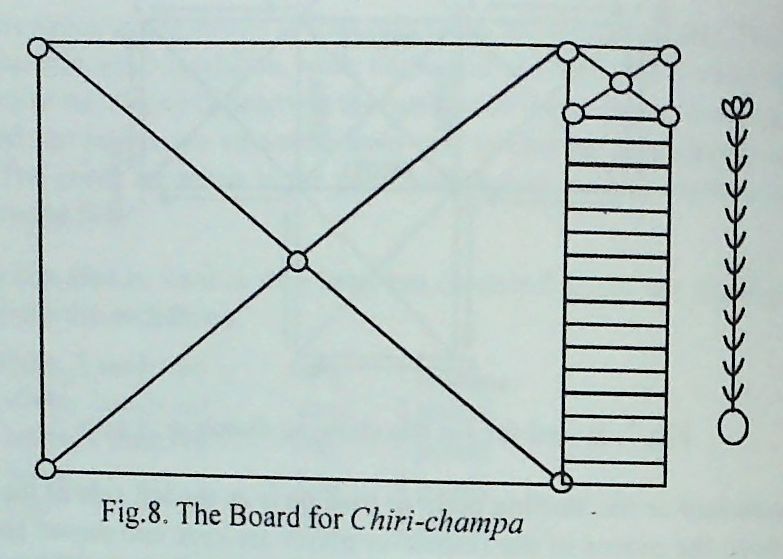
The board shown is drawn on the floor with the help of a piece of charcoal. It is usually of 15" by 15" size, with diagonal lines connecting corn passing through the kendra, or centre. To the right are steps leading to a step well in the upper right-hand corner. Outside the edge of the board is a date palm tree, its root shown at the base, and dates at the top. Note that there is the same number of protuberances on each side of the date plant.
The kendra here functions as starting point (normally khunt) for the game piece It is from the junction of the diagonal lines that the each piece travels firs passing in an anti-clockwise direction through the four corners. Then it goc (from upwards) down the stairs of the step-well to drink water. It then come back up the steps again, and climbs the date palm from one side. It takes a da) and descends down the date palm on the other side to conclude its journey i the root of the date plant.
This is a race game and the winner is the person whose piece first reaches to root of the date plant. This also marks the end of the set.
Any of the players starts the game by throwing the tamarind seed dice. In son areas four cowries replace the tamarind seeds. Scoring works as follows:
1 seed white, 2 seeds red eka 0 points, lose turn
2 seeds white, 2 seeds red jampo or champo 1 point + grace
3 seeds white, 1 seed red kania
0 points, lose turn
4 seeds white dhola kala
4 seeds red 4 points + grace
With throws of jampo, dhola and kala the player gets a grace throw, and he continues to throw, accumulating his score, until efo or fan/a turns up. The player advances his pieces accordingly.
This is a very exciting game. Even youths entertain themselves by playing Chin-champa.
Chiri-champa 'no. 2 is directly comparable to the game just described, with certain minor additions and differences. The additional elements are: 1 There is one clarified butter or ghee pot in each triangle of the central square. 2. There are four pots containing buttermilk in each triangle of the step-well. These are drawn in those places mentioned on the board, and are added points through which each horse (ghora) or game piece has to travel.
The starting point is once again the central junction of the diagonal lines which connect the corners of the square, and the journey ends at the root of the date palm. The piece moves from this starting point in an anti-clockwise as follows: first it travels from one ghee pot to the next, and then through the four corners, then it descends the step-well where it drinks water. Then it travels through the four buttermilk pots and comes back up the steps. The movement of the pieces up and down each side of the date palm is the same as in the previous game. The player whose piece first reaches the root of the date palm wins the race and the game. The scoring of the throws is the same as with the preceding game.
Either two boys or two girls usually play this game at leisure. Sometimes youths and even middle-aged people also try their luck in this game.
- Source (dcterms:source)
-
Indian Boardgame Survey by R.K. Bhattacharya, Irving Finkel, L.N Soni
- Contributor (dcterms:contributor)
- D.K. Samanta
- Format (dcterms:format)
- boardgames
- References (dcterms:references)
-
Indian Boardgame Survey by R.K. Bhattacharya, Irving Finkel, L.N Soni
- Spatial Coverage (dcterms:spatial)
- Rajasamant district of Mewar, Rajasthan
- Entered by (dcterms:accrualMethod)
- Souvik Mukherjee
- Media
 chiri gampa.jpg