Nine Men's Morris Kailash Temple, Ellora (2)
Item
- Title (dcterms:title)
- Nine Men's Morris Kailash Temple, Ellora (2)
- Description (dcterms:description)
-
Believed to be one of the oldest games in history, Nine Men's Morris is an alignment and configuration game that is found widely around the world. "Morris" comes from the Latin word "merellus", which means the corruption of pieces. The earliest known etching of Nine Men's Morris was found in an Egyptian temple in Kurna, Egypt (c.a 1440 BC). Other boards have been discovered in Ceylon of Sri Lanka (c. AD 10) and in the Gokstad Viking ship (c. AD 900). Evidence of the board scratched in the ground in the United States. To the ancient Celts, the Morris square was sacred. The central square known as the Cauldron or Mill was a symbol of regeneration while the lines and squares coming out from the middle were symbols of the four directions. Shakespeare mentions the game in his A Midsummer's Nights Dream. In India, many graffiti boards are to be found in temples and Buddhist caves.
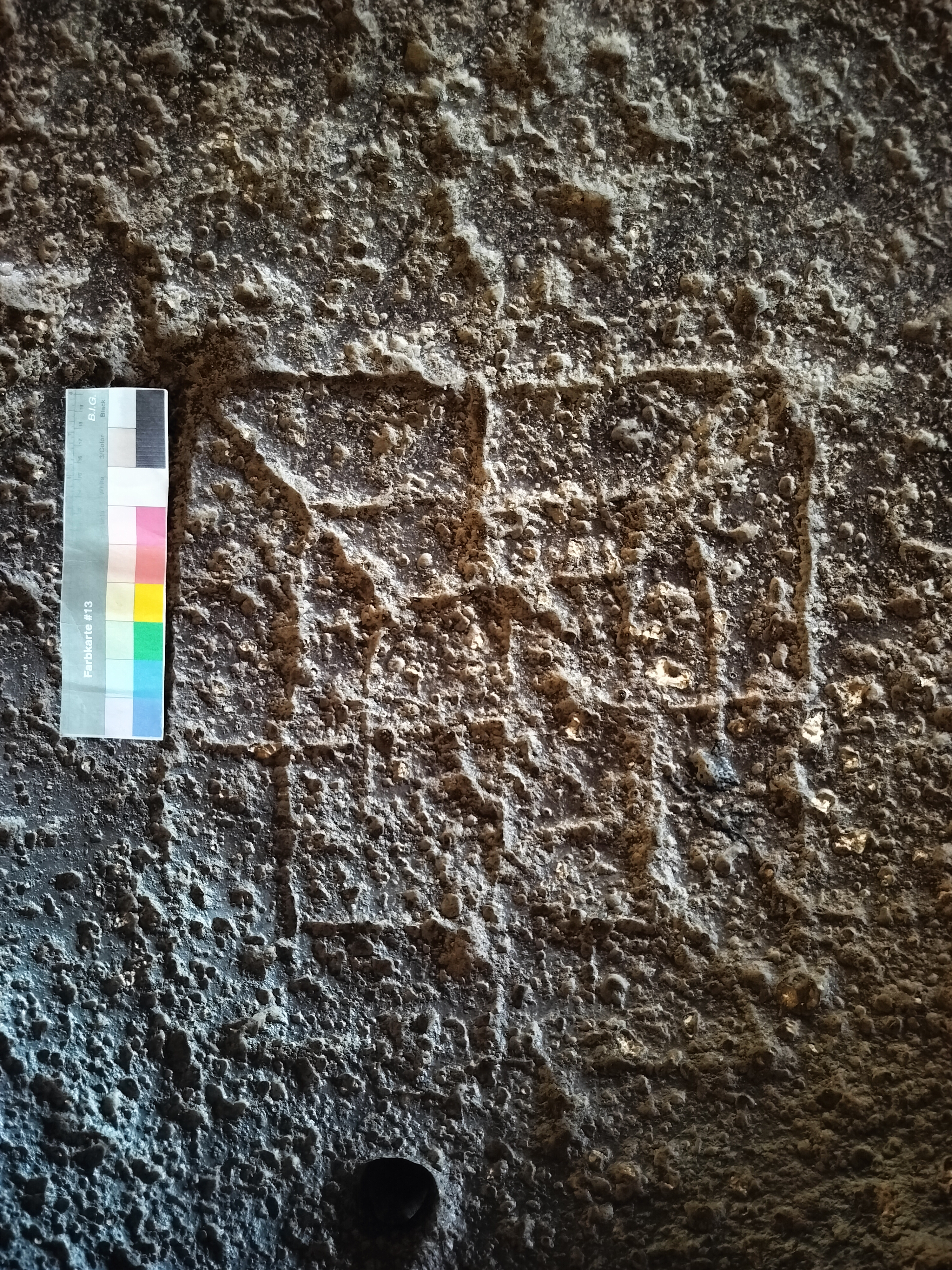
This is one such example of a graffiti board found in Kailash temple Ellora. The construction of the Kailash temple roughly dates back to the reign of Krishna I (r.756 – 774 CE) of the Rashtrakuta dynasty according to the Vadodara copper plate inscription. This copper inscription records and mentions Krishna I as the patron of the Kailashnatha temple and also mentions a shiva temple at Elapura or Ellora present day. - Alternative Title (dcterms:alternative)
- Dahdi, Navakankari, Merrells
- Rules (dcterms:instructionalMethod)
- It is played by two people on a simple grid board with three concentric squares and 24 intersection points. The goal is to get three of your pieces in a row, either horizontally, vertically, or diagonally. Players take turns placing their pieces on the board and moving them to adjacent spaces, trying to block their opponent's progress and create opportunities for themselves.
- Creator (dcterms:creator)
- Unknown
- Contributor (dcterms:contributor)
- Souvik Mukherjee and Adrija Mukherjee
- Rights (dcterms:rights)
- Creative Commons
- Format (dcterms:format)
- Graffiti boardgame
- Medium (dcterms:medium)
- Game board engraved/excavated on basalt rock floor
- Temporal Coverage (dcterms:temporal)
- Ellora Kailash temple of Cave 16 roughly dates to the 8th century CE.
- Spatial Coverage (dcterms:spatial)
- Ellora, Aurangabad, Maharashtra
- Entered by (dcterms:accrualMethod)
- Adrija Mukherjee