-
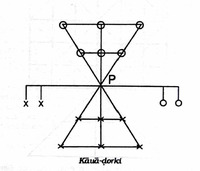 Kaua Dorki
 This game has been recorded by Charu Chandra Das Gupta in 1983 at Kosam village situated in the district of Allahabad. The informant of the game was Bacchu Singhala who was an inhabitant of the village. Das Gupta in his short essay further mentions about the similarities of Kaua Dorki and Egara-guti, or Lau-Kata-Kati or even Nao-Gutiya. The board as shown in the image has a common characteristic with the other games mentioned, which is that the two triangles meet each other at the apex. But one unique aspect of this game is that there is an additional horizontal line, intersecting the central point marked P, to which two vertical lines are drawn on each side and on where two pieces in possession of each player are placed at the beginning of the game.
-
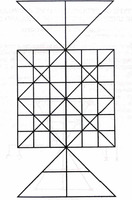 Mughal Pathan
 This game has been documented by Jatindra Mohan Datta in Belgharia, Kolkata near Dakshineshwar. According to Datta, the game is almost exclusive to the people who played this as it is found on a cemented floor of an old house. He also explains that this game is played like draughts. It is a two player game played by using 20 pieces. He also explains that a standard game of Mughal Pathan is also played with 16 pieces each and 19 pieces are used to play a variant of this game.
Mughal-Pathan has also been described by B. Das Gupta in Quarterly Journal of Bangiya Sahitya Parisat, under the title of Sola-guti Mangal Pata, in which reference is made to 16 pieces used by each player as well as to the wars between Mughals and Pathans in Bengal. Mughal-Pathan has also been described by B. Das-Gupta in Quarterly Journal of Bangiya Sahitya Parisat, under the title of Sola-guti Mangal Pata, in which reference is made to 16 pieces used by each player as well as to the wars between Mughals and Pathans in Bengal.
The board as seen in the diagram according to Datta, is used in playing several types of games, and he draws reference to the Bornean game of Rimoe described by Jacobson, the Ahtarah Guti of the United Provinces which is an 18-piece game described by Humphrey, Athara gutiala Teoraof the Central Provinces, also an 18-piece game described by H.C. Das Gupta, Lam Pusrior Sipahi Kat of the Teesta Valley an 18-piece game described by S.L. Hora and a new type of Bagh-Bandi or Tiger-play.
-
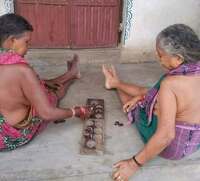 Kasadi
 Kasadi is a boardgame played by two players. It is usually played with either a wooden board with seven pits on both sides or even making pits or drawing circles on the ground if a board is absent. Kasadi is known as Thotogoti, KasaKaudi, and KanjiPata in different region of Odisha. According to its rules and the structure of the board it could also be stated as a variant of Mancala which is prevalent in several parts of India, known popularly by their local names.
It is believed that this game is also known as Sita- khel. Sources mention, when Sita was imprisoned in the Ashok vatika she was used to play this game.
The wooden board of kasadi or sita-khel was also available in the royal families of Odisha where the princes were used to play the game with their companions and were learning counting and measuring.
-
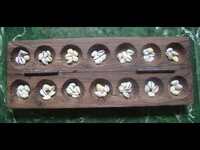 Interview with Professor Priya Sangameswaran (CSSSC): On Playing Pallanguzhi/Pallangudi in Palakkad
 On Playing Pallanguzhi/Pallangudi (Mancala) in Palakkad. Professor Priya Sangameswaran speaks to Dr Souvik Mukherjee about her experience of playing Pallanguzhi as a child and also later.
-
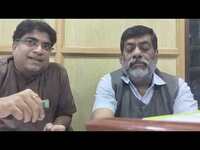 Interview with Ramsons Kala Pratisthana
 Interview with R.G. Singh and Raghu Dharmendra describing the initiation of interest in preserving boardgames.
Ramsons Kala Pratishtana (RKP) is a not-for-profit art foundation based in Mysore, Karnataka, India. RKP was established in 1995 to commemorate the 25th year anniversary of Handicrafts Sales Emporium (largest and finest handicrafts store in Mysore founded by D. Ram Singh in 1970).
RKP is a research, training, design, development and conservation centre for art and craft forms with special emphasis on Mysore and its culture. The main objective of RKP is to develop the art and craft forms by providing research based designs to the artisans and also creating a market to the products produced thereof. RKP aims to be proactive towards the sustainability of craft forms by providing them with new impetus in the face of globalisation and industrialisation.
The mantra is 'Art, craft and traditions have to reinvent themselves in order to be relevant with the times'
RKP conducts several annual exhibitions
'Kreedaa Kaushalya' an exhibition of traditional board games of India, in summer.
'Bombe Mane' an exhibition of traditional dolls on the occasion of Dasara.
'Deepa Soundarya' an exhibition of traditional lamps for Deepavali.
Chairman: D. Ram Singh. Executive Trustee: M.B. Singh. Secretary: R.G. Singh. Curator: Raghu Dharmendra See less
-
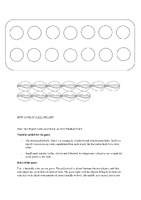 Rules of Pallankuzhi
 The Rules of Pallankuzhi played in Palakkad, Kerala
-
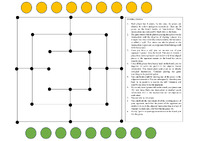 Nine Men's Morris: Downloadable Game
 This is a downloadable resource of a Nine Men's Morris Game one can download and play referring to the rules and using the given pieces.
-
 Pachisi: Downloadable Game
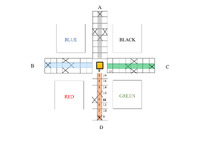
 This is a downloadable resource of a Pachisi Game one can download and play referring to the rules and using the given pieces.