-
 Bagh Bandi
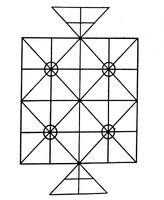
 This game has been recorded by Jatindra Mohan Datta In Basirhat in the 1930s. The name of the informant was Santosh Kumar Ray who explained that he used to play this game in his childhood. According to Jatindra Mohan Datta, the board or the diagram of the game shown here has similarities with the Mughal-Pathan game.
Bagh Bandi or Bagh Chal is played on a board by two players. Often, one players plays with four tigers, while the other has twenty goats. The tigers need to jump over and eat five goats whereas the goat needs to corner all the tigers to win. The game is the national game of Nepal and exists in multiple variations all over South Asia.
In the variation reported by Datta, this game is played with two tigers and thirty-two goats. the goats are placed in a group of eight at points enclosed by circles in the diagram at the beginning of the game. The two tigers are placed or can be placed anywhere on the board. It is then followed by the usual rules of Bagh Chal or Bagh Bandi. In this form, two or more captures are allowed one after the other but not by jumping forward and then backward over the goats.
-
 Tuk-Tak
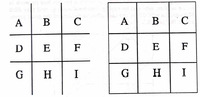
 This game has been recorded by Jatindra Mohan Datta as a sedentary game played in Bengal. According to Datta, this game was usually played by children and young boys and girls of Bengal. The diagrams used for the game are shown in the image, but it may be noted that the one without the outer boundary line is also used. The board is on a slate with chalk or on the floor using charcoal and it is a two player game.
-
 Mawkar Katiya
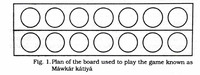
 Mawkar Katiya is a form of Mancala found in North-Eastern India. In his research published by the Asiatic Society in 1923 , Hem Chandra Dasgupta locates the game in North-Eastern India, particularly in Shillong and Cherrapunji .
-
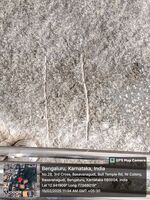 Incomplete Board, Bull Temple
 This board or this etching of a board could be speculated as the outer lines of Tablan. This etched board was found and recorded from Bull temple at Bangalore. This Bull temple consists of the largest stone carving of Nandi, the vahana (vehicle) of Lord Shiva. This temple was built by Kempe Gowda who was the the founder of Bangalore. This temple also has legends around it of the villagers worshiping the bull and has been on of the important centers of worship for the local people. This graffiti board lies on the left side of the porch. The temple is built in Vijaynagara style with the Nandi idol in the centre and porches on both sides. These porches have graffiti boards etched on them. This is one such board.
Tablan is a traditional Indian board game for two players, similar to Backgammon and Tâb, where the goal is to occupy more of your opponent's home squares than they do yours. [1, 2, 3, 4]
Here's a more detailed breakdown: [1, 4, 5]
Origin & History: Tablan is an ancient Hindustani game originating in India, particularly in some villages in Mysore, southwestern India. [1, 4, 5] It could have originated from the Roman games Duodecima Scripta .
Tablan is a "running fight" game from Mysore in India. Two bands of twelve warriors fight their way to each other's stronghold. Can you get more of your warriors into enemy territory than your enemy can get into yours? The game is a traditional blend of luck and strategy still played relatively recently.
History of Tablan
There is a class of games known as running fight games, in which two players advance towards each other on a straight course according to the throw of dice or casting sticks. But instead of being a race, the winner of a running fight game is decided by the capture of pieces when the game ends.
Tablan is a running fight game. Although the board is two-dimensional, it represents a single track which has been folded in on itself.
The game is a traditional one from India, of unknown antiquity. It is apparently related to a smaller, but more complex, game called tab, which was first described in the west in 1694. Whether tablan is the ancestor or descendant of tab is not currently known.
According to R. C. Bell, tablan was still being played in the villages in Mysore, southwest India, in the second half of the twentieth century. It has been made known in the west partly by Bell's own books. (source: Cyningistan.com)
-
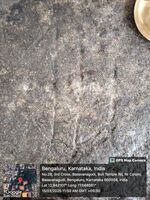 Bagh Chal, Bull Temple (4)
 The Basavanagudi Bull temple is a popular pilgrim location and is famous for largest stone carving of Nandi, the vahana (vehicle) of Lord Shiva. This temple was built by Kempe Gowda who was also known as the founder of Bangalore. The temple also has a lot of local folklore about villagers worshipping the bull. Hence from the time of its origin to present day, it is frequented by tourists, pilgrims and local people of the region. This graffiti board lies on the left side of the porch. The temple is built in Vijaynagara style with the Nandi idol in the centre and porches on both sides.
The image shows a Bagh Chal Board on the left side of one of the porches of the temple complex. A total of four kinds of Bagh Chal boards were documented from the Bull Temple.
Bagh Chal or Tigers and Goats is an ancient hunt game that has been popular in many regions of the world. The board of Bagh Chal is part of the alquerque family which traces its history to the Moors of Spain in their Libro de Los juegos (book of games) commissioned by Alfonso X in the 13th century. Although the rules were first found there, the history of alquerque goes further back to Egypt and to a name mentioned in the Kitab-al-Aghani (book of songs) as Kirkat or Al-Kirkat. Besides reference in literature similar game boards have been found both in practice amongst players in various communities as well as in archaeological sites. Bagh Chal has many variants, and is known by different names all over India, Nepal, Bhutan and other countries of South Asia. The structure of the board, the number of pieces and the variants in the rules may vary from place to place but the intention of winning remains the same. It is a two-player game where one individual represents the tiger and the other represents the goats. The number of tigers vary from one to even five in some games while the number of goats can be twenty or less or more depending on the structure of the board and the rules popular to the region.
-
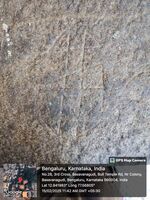 Baghchal, Bull Temple (3)
 This etched or incised Bagh Chal game board has been documented from the Bull Temple in Karnataka. It lies on the left side of the porch, second pillar from the entrance of the temple. Bagh Chal or Tigers and Goats is an ancient hunt game that has been popular in many regions of the world. The board of Bagh Chal is part of the alquerque family which traces its history to the Moors of Spain in their Libro de Los juegos (book of games) commissioned by Alfonso X in the 13th century. Although the rules were first found there, the history of alquerque goes further back to Egypt and to a name mentioned in the Kitab-al-Aghani (book of songs) as Kirkat or Al-Kirkat. Besides reference in literature similar game boards have been found both in practice amongst players in various communities as well as in archaeological sites. Bagh Chal has many variants, and is known by different names all over India, Nepal, Bhutan and other countries of South Asia. The structure of the board, the number of pieces and the variants in the rules may vary from place to place but the intention of winning remains the same. It is a two-player game where one individual represents the tiger and the other represents the goats. The number of tigers vary from one to even five in some games while the number of goats can be twenty or less or more depending on the structure of the board and the rules popular to the region.
The Basavanagudi Bull temple is a popular pilgrim location and is famous for largest stone carving of Nandi, the vahana (vehicle) of Lord Shiva. This temple was built by Kempe Gowda who was also known as the founder of Bangalore. The temple also has a lot of local folklore about villagers worshipping the bull. Hence from the time of its origin to present day, it is frequented by tourists, pilgrims and local people of the region. This graffiti board lies on the left side of the porch. The temple is built in Vijaynagara style with the Nandi idol in the centre and porches on both sides.
-
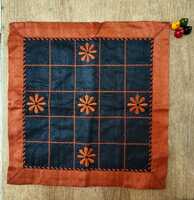 Chowka Bara, Handmade
 Chowka Bara, also known as Ashta Chamma, is a traditional Indian board game that dates back to ancient times. Although the exact place of origin and the period remains unknown, this boardgame has been popular in various places across India through generations. The game is played by two or four players using four cowrie shells and several tokens. The name “Chowka Bara” means “four eight,” which are the highest numbers a player can get from the cowrie shells. The game likely started in Andhra Pradesh, Telangana, or Karnataka. It is called 'Athha Pagdi' in Gujarat and 'Chiti' among the Baiga Community in Madhya Pradesh. In Karnataka, it is called “Chowkabara,” in Andhra Pradesh and Telangana, it is known as “Ashta Chamma,” and in Tamil Nadu, it is called “Daayam.” Each region has its own small changes to the rules, adding to the game’s rich variety. This game is known by various names in different languages and regions across India. t’s thought to be one of the cross-and-circle games, like Pachisi, Ashte Kashte, and Chaupar.
The Chowka Bara board always has the same number of tiles across and down, but the tiles don’t have to be square. The number of tiles varies, allowing for bigger boards and longer games. There is always an odd number of tiles so there can be a central tile. Each player uses one less token than the number of tiles on one side of the board. The goal is to get all of one’s tokens to the central tile first.
Variants: Among the Baiga Community in Madhya Pradesh, the game can be played by 2 3 or 4 players and each person is alloted 4 pices called khunti. 5 pieces of halved tamarind seeds are used as dice. The throw of the dice is called chiti.
-
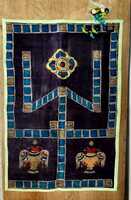 Panchi, Handmade
 Panchi is a two player race game with five pieces per player. One of the earliest mention of the game came from Maharaja Mummadi Krishnaraja Wadiyar III who was the king of Mysore between 1799 and 1868 C.E. His contribution of six encyclopedic compilation of manuscripts included the first mention and the rules of this game. A brass plate of a carved Panchi board is currently a part of the collection of board games at the British Museum. The rules of the game were later recorded and written by R. Vasantha in 'Maharaja’s Games and Puzzles'.
This board is made by Ramsons Kreera Pratisthan on Kalamkari. They are working towards the revival of traditional Indian Boardgames through manufacture of handmade boards, casting pieces and counters. They collaborate with artists and artisans all across India to make such boardgames and their material have a number of varieties such as, Navalgund Jamkhana, Silk embroidery, Batik print, Mysore silk zari weaving etc. Other than variants in types of cloth and handloom they also manufacture boardgames on Marble, Mysore wood, Brass Casting, Wood Polychrome and many as such.