-
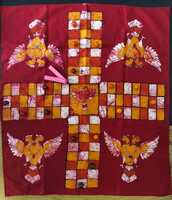 Chaupar, Handmade
 The first description of this game seems to have been written in the 16th century, when chaupar was a common gambling sport at the court of the Mughal emperor Akbar in Agra and Fatehpur Sikri. Abul Fazl describes how the game is played with sixteen pieces, three dice, and a “board” in the shape of a cross.
The history of chaupar is linked to that of pachisi, not least because the boards are identical and that it is therefore impossible to see which of the two games an archaeological example belonged to.
Also known as chausar or chaupad, this game has many similarities to the more well-known pachisi. A cross-shaped board hosts the pieces of four players, who play in two partnerships, each player having four pieces. The pieces begin at fixed positions around the board, racing around the board to finish at the centre. The game has also attracted much attention in the West and in colonial India. Thomas Hyde wrote about the game in his De Ludibus Orientalibus in 1694 followed by many other commentators and an 1851 painting of men playing chaupar by William Carpenter. Edward Falkener also published a detailed account of Pachisi in his Games Ancient and Oriental and How to Play Them in London in 1892 .
There are multiple versions of chaupar and the rules and material vary. The Rajputs traditionally play the game during the entire night of a wedding, along with chanting, drinking tea and other beverages as well as smoking or chewing tobacco products. The Sodha Meghwals and the Rabaris faithfully follow the tradition of the Rajputs and play the game during marriage or any such festive occasion. The Rabari play the game on a board with seven khana (rooms) on each row, while the board of the Meghwal and the Rajput possesses eight squares on each row. The game is played with six cowries locally known as khairiya by the Rabari and with seven cowries both by the Rajput and the migrant Marvada group of the Meghwal of Sumrasar. It is also played by the Patwal families in Haryana and as Dosh Pochish among Sylheti communities.
This Chaupar board is made of Batik print cotton cloth by Ramsons Kreera Pratisthan. They are working towards the revival of traditional Indian Boardgames. It also depicts the symbol of the Mysore royal family.
Ramsons manufactures hand-made gameboards, casting pieces and counters. They collaborate with artists and artisans all across India to make these boardgames and their material have a number of varieties such as, Navalgund Jamkhana, Silk embroidery, Batik print, Mysore silk zari weaving etc. Other than variiants in types of cloth and handloom they also manufacture boardgames on Marble, Mysore wood, Brass Casting, Wood Polychrome and many as such.
-
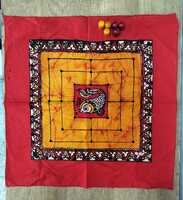 Nine Men's Morris, Handmade
 Nine men's morris is a classic game of pure strategy. It has been described as "noughts and crosses for adults", as it shares the simpler game's aim for forming rows of three, but weaves that aim into a much more sophisticated game of wits. It is mentioned in Shakespeare's A Midsummer's Night's Dream where Titania says, 'The nine men's morris is filled up with mud' (Act 2 Scene 1: ll. 98-100). A similar game is also mentioned in Ovid's Ars Amatoria.
The rows of three, called "mills", are not the main aim of the game, they are a means to an end. The board starts empty, and players place their pieces in turn; forming a row of three allows the removal of an enemy piece. When all pieces are placed, they slide from one position to another, still trying to form mills and capture enemy pieces. The aim of the game is to reduce the opponent to two pieces, rendering them unable to form any more mills.
The game of nine mens morris is so ancient that we do not know its origin. From the stones of ancient Kurna in Egypt, to the stone- or bronze-age burial sites of Cr Bri Chualann, in County Wicklow in Ireland, the pattern for the board has been found in many ancient contexts.
This particular board is made of cotton with a batik print on it which is popular in Bengal. This board is made by Ramsons Kreera Pratisthan. They are working towards the revival of traditional Indian Boardgames through manufacture of handmade boards, casting pieces and counters. They collaborate with artists and artisans all across India to make such boardgames and their material have a number of varieties such as, Navalgund Jamkhana, Silk embroidery, Batik print, Mysore silk zari weaving etc. Other than variants in types of cloth and handloom they also manufacture boardgames on Marble, Mysore wood, Brass Casting, Wood Polychrome and many as such.
-
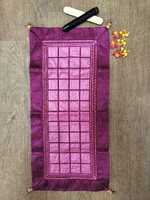 Tablan, Handmade
 Tablan is a traditional Indian board game for two players, similar to Backgammon and Tâb, where the goal is to occupy more of your opponent's home squares than they do yours. [1, 2, 3, 4]
Here's a more detailed breakdown: [1, 4, 5]
Origin & History: Tablan is an ancient Hindustani game originating in India, particularly in some villages in Mysore, southwestern India. [1, 4, 5] It could have originated from the Roman games Duodecima Scripta .
Tablan is a "running fight" game from Mysore in India. Two bands of twelve warriors fight their way to each other's stronghold. Can you get more of your warriors into enemy territory than your enemy can get into yours? The game is a traditional blend of luck and strategy still played relatively recently.
History of Tablan
There is a class of games known as running fight games, in which two players advance towards each other on a straight course according to the throw of dice or casting sticks. But instead of being a race, the winner of a running fight game is decided by the capture of pieces when the game ends.
Tablan is a running fight game. Although the board is two-dimensional, it represents a single track which has been folded in on itself.
The game is a traditional one from India, of unknown antiquity. It is apparently related to a smaller, but more complex, game called tab, which was first described in the west in 1694. Whether tablan is the ancestor or descendant of tab is not currently known.
According to R. C. Bell, tablan was still being played in the villages in Mysore, southwest India, in the second half of the twentieth century. It has been made known in the west partly by Bell's own books. (source: Cyningistan.com)
This particular board is made of Silk embroidery by Ramsons Kreera Kaushalya. They are working towards the rrevival of traditional Indian Boardgames. They manufacture handmade gameboards, casting pieces and counters. They collaborate with artists and artisans all across India to make these boardgames and their material have a number of varieties such as, Navalgund Jamkhana, Silk embroidery, Batik print, Mysore silk zari weaving etc. Other than variants in types of cloth and handloom they also manufacture boardgames on Marble, Mysore wood, Brass Casting, Wood Polychrome and many as such.
-
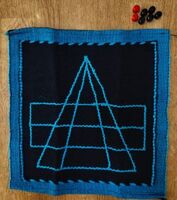 Baghchal, Handmade
 Bagh Chal or Tigers and Goats is an ancient hunt game that has been popular in many regions of the world. The board of Bagh Chal is part of the alquerque family which traces its history to the Moors of Spain in their Libro de Los juegos (book of games) commissioned by Alfonso X in the 13th century. Although the rules were first found there, the history of alquerque goes further back to Egypt and to a name mentioned in the Kitab-al-Aghani (book of songs) as Kirkat or Al-Kirkat. Besides reference in literature similar game boards have been found both in practice amongst players in various communities as well as in archaeological sites. Bagh Chal has many variants, and is known by different names all over India, Nepal, Bhutan and other countries of South Asia. The structure of the board, the number of pieces and the variants in the rules may vary from place to place but the intention of winning remains the same. It is a two-player game where one individual represents the tiger and the other represents the goats. The number of tigers vary from one to even five in some games while the number of goats can be twenty or less or more depending on the structure of the board and the rules popular to the region. While etched boards or boards scribbled on the ground is a tradition in many regions in South Asia, popular bagh chal boards are now being manufactured on paper and cloth and different variants are being made by the handmade industry. This particular board is made of Solapur Dhurry [handwoven rugs] by Ramsons Kreeda Pratisthana, from Mysore.
-
 Kati
Kati Description of Kati, a game played by Santhal communities in Jharkhand, India
-
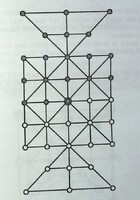 Atharah Guti (Eighteen Pieces)
 This game was documented by Humphries in The karvi subdivision of Uttar Pradesh. While it is called Ahtarah Guti in Uttar Pradesh it is also known as Bazi Mar, Ticcha or Bangala. This board also has similarities with other boards such as Mughal Pathan or other types of Alquerque boards like Atharagutiala Teora, Sipahi Kat, or Lam Pusri. It is a two-player game played on a space of thirty seven as shown in the image. Each of the two players have eighteen pieces to play the game. The game is played by captures and ends with one player capturing his opponents pieces or ‘men’ as Humphries calls them.
-
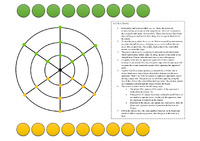 Pretwa: Downloadable Boardgame
 This is a downloadable resource to help you learn Pretwa
-
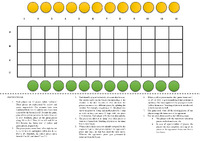 Tablan: Downloadable Game
 This is a downloadable resource to help you learn Tablan