-
 Tablan
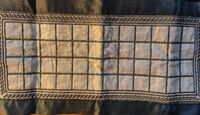
 Tablan is a traditional Indian board game for two players, similar to Backgammon and Tâb, where the goal is to occupy more of your opponent's home squares than they do yours. [1, 2, 3, 4]
Here's a more detailed breakdown: [1, 4, 5]
Origin & History: Tablan is an ancient Hindustani game originating in India, particularly in some villages in Mysore, southwestern India. [1, 4, 5] It could have originated from the Roman games Duodecima Scripta . Tablan is a "running fight" game from Mysore in India. Two bands of twelve warriors fight their way to each other's stronghold. The game is a traditional one from India, of unknown antiquity. It is apparently related to a smaller, but more complex, game called tab, which was first described in the west in 1694. Whether tablan is the ancestor or descendant of tab is not currently known. According to R. C. Bell, tablan was still being played in the villages in Mysore, southwest India, in the second half of the twentieth century. It has been made known in the west partly by Bell's own books. (source: Cyningistan.com)
It is apparently related to a smaller, but more complex, game called tab, which was first described in the west in 1694. Whether tablan is the ancestor or descendant of tab is not currently known.
-
 Nine Men's Morris/ Dahdi, Ellora
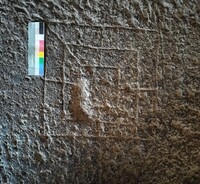
 Nine Men's Morris is one of the oldest games of the world which has spread across the world. The earliest known etching of Nine Men's Morris was found in an Egyptian temple in Kurna, Egypt (c.a 1440 BC). Other boards have been discovered in Ceylon of Sri Lanka (c. AD 10) and in the Gokstad Viking ship (c. AD 900).
The Board game here is located in the Kailash temple in Ellora.
-
 Nine Men's Morris
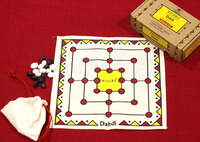
 Believed to be one of the oldest games in history, Nine Men's Morris is an alignment and configuration game that is found widely around the world. "Morris" comes from the Latin word "merellus", which means the corruption of pieces. The earliest known etching of Nine Men's Morris was found in an Egyptian temple in Kurna, Egypt (c.a 1440 BC). Other boards have been discovered in Ceylon of Sri Lanka (c. AD 10) and in the Gokstad Viking ship (c. AD 900). Evidence of the board scratched in the ground in the United States. To the ancient Celts, the Morris square was sacred. The central square known as the Cauldron or Mill was a symbol of regeneration while the lines and squares coming out from the middle were symbols of the four directions. Shakespeare mentions the game in his A Midsummer's Nights Dream. In India, many graffiti boards are to be found in temples and Buddhist caves.
-
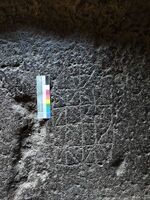 Bagh Chal, Ellora
 This etched or incised Bagh Chal game board has been documented from the Kailash temple (cave 16) of Ellora. Bagh Chal or Tigers and Goats is an ancient hunt game that has been popular in many regions of the world. The board of Bagh Chal is part of the alquerque family which traces its history to the Moors of Spain in their Libro de Los juegos (book of games) commissioned by Alfonso X in the 13th century. Although the rules were first found there, the history of alquerque goes further back to Egypt and to a name mentioned in the Kitab-al-Aghani (book of songs) as Kirkat or Al-Kirkat. Besides reference in literature similar game boards have been found both in practice amongst players in various communities as well as in archaeological sites. Bagh Chal has many variants, and is known by different names all over India, Nepal, Bhutan and other countries of South Asia. The structure of the board, the number of pieces and the variants in the rules may vary from place to place but the intention of winning remains the same. It is a two-player game where one individual represents the tiger and the other represents the goats. The number of tigers vary from one to even five in some games while the number of goats can be twenty or less or more depending on the structure of the board and the rules popular to the region.
The construction of the Kailash temple roughly dates back to the reign of Krishna I (756 – 774 CE) of the Rashtrakuta dynasty according to the Vadodara copper plate inscription. This copper inscription records and mentions Krishna I as the patron of the Kailashnatha temple and also mentions a shiva temple at Elapura or Ellora present day. This particular carving has been found beside a series of fire altars in the Kailash temple. This board quite interestingly has a lot of similarities to another Tigers and Goat board documented in Orissa by Hem Chandra Das Gupta in Sedentary Games of India (Das Gupta 1999 :92). That variant was played by one tiger and twelve goats. Although it is difficult to assess the rules for the board found at Kailash Temple it is a possibility to trace similar rules of Bagh-Chal played in the region of Maharashtra.
-
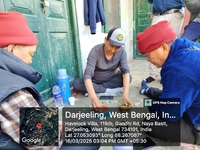 Para Sho (Tibetan Board Game)
 Para Sho is a cherished traditional game in Tibetan culture, where players toss wooden dice into a bowl, blending the elements of luck and strategy. Often played during festivals and social gatherings, this game has been a source of joy and connection among Tibetan communities for generations.
The game is almost forgotten even in the Tibetan communities in India but a few players remain in Darjeeling and nearby regions. Three players were observed and the play experience documented at the Tibetan Refugee Centre in Darjeeling. The players play this game from 10 am to 5 pm every Sunday. The game is still played during Losar, the Tibetan new year.
The players often use Tibetan words that are specific to this game.
-
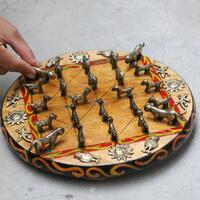 Bagh Chal
 Bagh Chal is played on an alquerque board by two players. One has four tigers, while the other has twenty goats. The tigers need to jump over and eat five goats whereas the goat needs to corner all the tigers to win. The game is the national game of Nepal and exists in multiple variations all over South Asia. There are multiple variants of the game across South Asia.
-
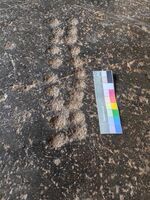 Mancala, Bhaja Cave Complex
 This etched or incised board is located in the main chaitya griha of the Bhaja cave complex (Cave number 12).
The game of Mancala is considered to be one of the oldest games of the world, while its place of origin and the timeline is debatable. The earliest textual reference as stated by scholars comes from Kitab al-Aghani, or Book of Songs which does not directly mention mancala but refers to a similar game. These rows of cupules have been excavated in ancient sites like Jordan and many others including megalithic sites in India but their link as to being Mancala is debatable. This game has many variants all across the world and is popular in Africa, Asia, and parts of Eastern Europe. In India, Mancala is known by many names. The rules and variants of the game keep changing based on its region and according to the communities who play them. The number of holes in mancala differ along with the number of rows as well. In some variants the board is hand-drawn on a surface as circles with chalk or even cut holes on the soil to play the game. It is played with local seeds, stones or anything which is easily available as pieces to place inside the pits. The number of pieces per pit also vary from four to even twelve in some variants. This game is popularly a two player game but some variants also show three players or even one in some case.
In Bhaja Caves and in many other caves in western Deccan the evidence of mancala board depressions or carvings are present. This is an example of one such game board.
This is an 11 hole mancala with 2 rows. The approximate length of the board is 35cm. the width is uneven and approximately measured at 6cm. The diametre of the holes are uniform and measured as 3cm.
This mancala board lies on the left hand side of the chaitya griha facing the stupa lying beside the chaupar board at the same cave.
Etched games or games inscribed have been documented by scholars and board game researchers from many sites of India, both at religious and secular spaces. From sites like Lothal (Indus Valley) to game pieces found at Mohenjodaro, to reference of scholars at books like Sedentary Games and The Boardgame complied by the Anthropological Survey of India, etchings of game boards have been found on stone slabs of places where people gathered, in temple porches or floors of temples and stupa complex.
-
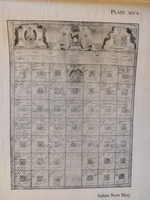 Tibetan Game of Rebirth and Liberation (Sa lam rnam bzhag)
 The Tibetan Game of Rebirth and Liberation is a variant of the Gyan Chaupar game, arguably. It is about the attainment of nirvana in either the Sutra way or the Tantra way. The game consists of a checkered board with each square being inscribed with scenarios from life and Buddhist philosophy. Each square leads to other squares depending on the throws of dice. The game itself is hypertextual and there are multiple outcomes possible from the throw of dice after the players reach any particular square on the game board.
The following quotation from the Indian Museum's publication provides a detailed idea about the game:
This is a fortune-telling thanka and as a sort of game, "the game of Rebirth", it is played with dice. Unlike other thankas this thanka is interesting fpr its subject matter, which neither depicts a deity nor a monk but a sort of religious game - a popular game of the Tibetan people. Though the subject is different the ultimate goal of the game as depicted in this painting, like other thankas is the same, i.e. nirvana or final liberation. Salam Nam Shag actually describes the path (marga) and the suc- cessive stages (bhumi) of spiritual progress for attaining nirvana. The game was invented by Sakyapandita, the great Sanskrit scholar and guru of the Sakya sect in the early 13th century A.D. The thanka shows seven horizontal and seven vertical rows representing seven squares in each row. These squares which symbolically represent the 'board' of the game and cosmic geography illustrate the paths to enlightenment and final libera-
tion.
At the top are shown the figures of Amitayus in Sukhāvatī heaven, Vajradhara in yab-yum in vajrahum kāramudra and Vajrayogini. In this thanka, devaloka, daityaloka, manuṣyaloka, nagaloka, paśuloka and naraka have been illustrated with representations of deities, arhats, śrāvakas, asuras, nagas, beasts and the sufferings in hell. The game is started from the human realm and with the cast of a dice one proceeds upward or down- ward either to devaloka or to the lower states of rebirth or naraka. The winner in the game of rebirth reaches the realm of Buddhahood and nirvāņa' (Chakravarti 2000, 28)