-
 Golok Dham
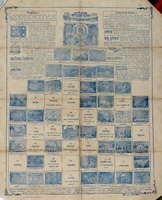
 Golok Dham is a variant of Gyan Chaupar but instead of snakes and ladders, it portrays multiple place names and moral situations on a grid. The game seems similar to Western moral education games such as Mansions of Happiness but a greater similarity is observed with Sa lam nam bzhag, the Tibetan Game of Rebirth and Liberation. The game is clearly Vaishnavite and ends with the player reaching GolokDham or the abode of Vishnu. The game is a proto-hypertext because it often offers multiple moves from the same square based on the dice throws of the player.
'The board designed with arrays [was] printed first at the Tara Art Press, date of its initiation almost coincided with the time when in 1 870s and 1 880s, the religious and mythodological pictures were being produced by numerous small presses of Battala locality.3 A specific reference of this game is found in the conversation of Shree Ramakrishnadeb on 2nd October 1884. Ref. Shreema Kathita "Shree Shree Ramkrishna Kathamrita", Kalikata, 1339, Vol. IV, p. 179. The pictures used were stylistically next of kin of the kind of mythological pictures produced by those small presses throughout this period. As an instance the chromolithographie picture of Radha and Krishna, a production by the Kansaripara Art Studio may be cited.4 The picture given on the top of the golokdham game board (square no. 64) seems almost to be a replica of the aforesaid chromolithograph. The treatment of the mytho- pictures produced by the artists of Kansaripara or Chorebagan was cruder than the Calcutta Art Studio prints. ' (Bagchi 2005)
-
 Gyan Chaupar board (Jain version), Lokapurush motif
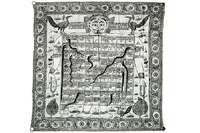
 Calico Museum, Ahmedabad, acc. no. 98422 (fig. 4). Executed by Pandit Tej Vijaya Ganin (?) and dated Phalgun V. S. I 890/I 8 34 A. D. A boldly painted and attractive board of the lokapurusa type, with a background of peacocks, stylised plants and trees, within a floral border in orange, ochre, pink and olive green.
The gyan chaupar board used by the Jains of western India in the 18th and 19th centuries has 84 numbered squares, comprising a 9 x 9 square grid with three extra squares (I, 5 6, 66) at bottom left and at either side. Several additional squares (with separate numbering) generally appear above the main playing area, often enclosed within an architectural structure resembling a palace or temple (nos. II, I2, I5, I8). These squares are named Vijaya, Vaijayanta, Jayanta and Aparajita, with Sarvarthasiddha above them, and represent the vimanas of the Pancanuttara heaven, the highest of the heavenly regions according to Jain cosmology.15 Higher still is the crescent shape of Isatpragbhara (called Siddhasild or Muktiksetra on the boards themselves), the umbrella-shaped region at the topmost point of the universe, the abode of perfected souls who enjoy the eternal bliss of liberation.16 In the other principal variety of the Jain game, the playing area forms the body of the lokapurusa or Cosmic Man, whose head, arms and feet protrude from its sides (nos. IO, I4). The face of the lokapurusa and the crescent on his forehead again represent the Pancanuttara heaven and Tsatprdgbhdra.17 In keeping with the Jain passion for cosmological classification and theorising about the laws of karma, the nomenclature of the squares through which the player progresses is more systematic and detailed than in the Hindu forms of the game. There is some variation in nomenclature: whereas board no. IO, dated I834, uses long descriptive cap- tions for the squares, these are often abbreviated and simplified in later igth century boards. Some names, especially of spiritual vices, are shared with the Hindu game, e. g. krodha and the long snakes of tamas-ahankara (square 67 in nos. 13 and I 5) and rajas-ahan- kdra (leading from 75 to 2 in no. IO, much like the ahankara to maya snake in the 72-square Vaisnava board). The snakes in general represent the spiritual defilements which hinder the soul in its long upward journey from the various hells or the condition of the nigodas, the very lowest form of life, to the heavens and ultimate liberation. In no. I 5, for example, the snake squares include maithuna-saivyd (lust, 13); mithjydtva gunasthdna (17, "lack of insight", the lowest of the I4 gunasthdnas or stages of purification);18 lesyd nila (74, "blue lesya", the second darkest or most defiled of the "shades" of the soul); krsna lesya (75, "black lesya", the darkest of all); while the final snake (76) is mohanfya-karma, the residual karmas which cause the soul to become confused and desirous.19 In Jain doctrine, such karmic impediments must be dealt with by upasama ("suppression": ladder squares 7 and 44) or ksaya ("obliteration": ladder square 47).
-
 Gyan Chaupar board (Jain Version)
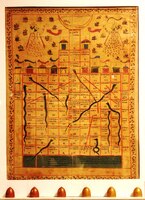
 This 'is an example of the Jain version of the game. (Fig.1) It seems to follow the basic rules of the religious philosophy. Though unlike the nine snakes and five ladders seen in most Jain gyan chaupar boards, it has a distinctly coloured extra snake at the topmost box. It is a late-eighteenth century board painted on cloth in the usual 84-box style (9 x 9 plus three additional boxes at 1, 46, 66). The snake at the highest box on the left (76) is the mohani-karma—confusion and desire trying to catch hold of the jiva before it attains enlightenment.[5] This board follows the conventions of the Rajasthani school of painting, evident from the line work on the divine figures at the top, Devanagari inscriptions, floral creeper patterns and red–black colour contrast.' (Srivastava, Sahapedia.org)
Gyan Chaupar or Gyan Bazi is the predecessor of Snakes and Ladders. The Jain version in the National Museum is shaped liked a Rajput fort but most of the boards are shaped like the Lokpurush, or the man who symbolises of the universe, with the three worlds (heaven, earth, and hell) mapped onto his body, illustrating the Jain understanding of the cosmos.
-
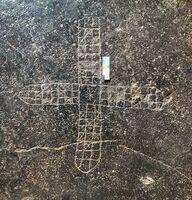 Chaupar, Bhaja
 This is a chaupar grafitti board documented in Bhaja cave number 12 which is the chaitya griha of the bhaja cave complex. According to anthropologists K. Ravi and Jaya Sankar Rao and the classification of HJR Murray in his book, The History of Boardgames Other Than Chess, Chaupar is categorised as a Race Game. It is typically a four player game and the pieces belonging to each player is distict from the others. It is played with four pieces and a throwing of either cowrie shells or two oblong dice. There are various terminologies used for the safe squares, or the throws which differs from one region to the other. For example, in Haryana the central home which is a flower here is called 'charon ka ghar' (Bhattacharya, Finkel and Soni 2011). Interestingly, it can be played by a throw of six cowrie shells or even more depending on the variant. As this etched board is from Maharashtra, it is difficult to understand the exact throw of dice or cowries used or the rules made to play this game. There is currently a version of chaupar in Maharashtra called Saripat.
Bhaja is one of the oldest rock cut cave complexes of the Hinayana period.
The board is etched on the floor of the main chaitya griha on the left hand side facing the stupa. The limb facing the stupa is 42cm on both sides. The middle square or rectangle is 15cm facing the stupa. The width of the limb is 14cm on both sides approximately. On all limbs, there are 6 safe squares. Safe square on the 4th and 7th square is situated on both extremes while square number 3 and 6 is situated in the middle column. There is a floral pattern in the centre.
Etched games or games inscribed have been documented by scholars and board game researchers from many sites of India, both at religious and secular spaces. From sites like Lothal (Indus Valley) to game pieces found at Mohenjodaro, to reference of scholars at books like Sedentary Games and The Boardgame complied by the Anthropological Survey of India, etchings of game boards have been found on stone slabs of places where people gathered, in temple porches or floors of temples and stupa complex.
-
 Interview with Ganjapa [Ganjifa] artist Banamali Mahapatra
 Ganjapa ( Ganjifa) artist Banamali Mahapatra describes the process of the making of the ganjapa cards, their relation to the patachitra.
-
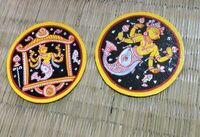 Raja (King) and Mantri (Vizier) card
 Ganjifa cards of Raghurajpur: The raja card is usually depicted with a chariot and is the card with the highest points. The mantri card is without the chariot.
-
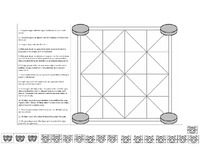 Bagh Chal: Downloadable Game
 This is a downloadable resource to help you learn Baghchal
-
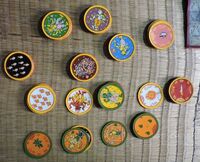 Dashavatar Ganjifa Card, Raghurajpur
 The Dashavatar Ganjifa cards of Raghurajpur Orissa are playing cards featuring the 10 avatars of Vishnu namely Matsya, Kurma, Varaha, Narasimha, Vamana, Parashuram, Rama, Balaram, Jagannath and Kalki. The total set contains 120 cards which includes 10 suits. Each suit contains one Raja or the king card, one Mantri or the vizier and ten number cards.