-
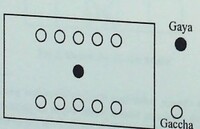 Gaya gaccha
 The name of this dexterity game for children is Gaya gaccha. The game piece 'ghuti' lying in the central place, or 'gaya,' must be struck by another ghuti to win the game as a whole. This signifies total loss to the opponent and marks the end of the game. A ghuti lying on its side is called gaccha, If a gaccha is hit, the said gaccha is won by that player, which indicates a partial loss to the opposition who must surrender that particular ghuti to the striker. These expressions are used verbally in the game.
Normally, the players consist of five to ten in number but the minimum number of players is two. The number of ghuti depends on the number of players; in that there must be one more ghuti than the number of players, as there must be one in the central position as winning over the ghuti in the central position is the aim of all the players.
The ghuti chosen for the game is kul or ber (black berry). It may also be of round marbles. There are no other special rules for the game. Normally fruits are chosen as ghunti by boys and girls because they like to taste them. The players can be of either sex, although boys are preferred. The age of the players is below fifteen years and there is no restriction of players in terms of economic and social status. It is normally played in leisure time or during grazing. It is played on the village road but preferably under the shadow of a tree. The layout of the board is simple and is drawn on using brick pieces. It may be square or rectangular in shape.
-
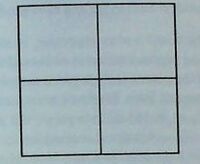 Tikda
Tikda This game is played by people of various ages, but only by men. The equipment needed is a square board and two sets of three game pieces, one for each player. Small pebbles of different sizes and colours are used as pieces. The square board is drawn on the floor with the help of a piece of charcoal.
Tikda is a blockade game. Players take alternate turns. The pieces are placed first in corners but not in a row. The players try to position their pieces in a row or sequences. Simultaneously each player erects a blockade in such a way that his opponent cannot place his pieces in a row. The player who becomes successful in placing his pieces in a row wins the set. One round consists of five sets. The winner of the maximum number of sets wins the round. This game is very popular among the younger boys, and is also useful for mental development.
-
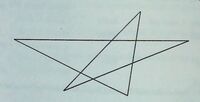 Tara
Tara For this game the necessary equipment consists of a star-shaped board and nine pieces. Two or more players play Tara usually young boys, school going girls also play this game. The board is drawn on the floor with charcoal.
-
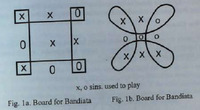 Bandiata
 This is a two player game. According to Kulirani and Vijayendra this game is known as bandiata in the districts of nothern Karnataka. Bandi means cart which adds to the meaning of a bullock cart or vehicle while ata means play in Kannada. The board is usually drawn or sketched on the ground with a piece of chalk or is even drawn on paper with a pen.
-
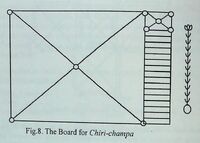 Chiri-champa or Siri-champa or Siri-gampa or Siri-jampa
 Chiri or Siri, means 'stair' and here 'champa' is the term for a split tamarind seed used as a dice. The equipment consists of a square board, four split and two game pieces for each of the two players. Such games are played in peak summer months during the lean agricultural season or on a rainy day when farm activities are not possible, or when the maize crop is half grown. During this period there remains a minimum farm activity.
The variant Siri-champa is played in lean agricultural seasons. Women of the area do play this game. It is a race game.
-
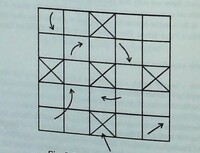 Chalar
 This is played on a 5X5 board. Four women play at a time with four gaming pieces of four different colour {sari) made of broken bangles, and four cowries as dice. In the absence of cowries, broken pieces of earthenware can be used as dice by colouring the upper side in white.
-
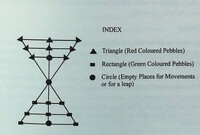 Nau Khant
 The Nau khant is played in the rural areas of the Mahendragarh district of Haryana state as much as the two preceding games. A set of nine pieces (gutis) of one colour is used by each player. Only two members can play this game, hence pieces of two colours are used.
The board, which consists of nineteen points in two triangles, is drawn on a floor with a piece of charcoal, brick or chalk. Either of the players can start the game. The placement of pieces is made in such a way that the opponent will not have the possibility of jumping over his rival's piece. Piece stationed on any point, can move in any direction along any marked line through that point to the next point on that line, which must be empty. If the adjacent point is occupied by the opponent's piece and the next point beyond it on the line is empty, then the player can make the piece leap over his opponent's to the vacant point beyond, and take the opponent's piece.
Similar leaps can be made by either of the players. One of them can become the winner of the game by taking more leaps and thus capturing his opponent's pieces.
-
 Nau Bhar
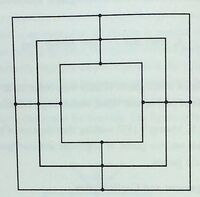
 This board game can be reported as being played in the villages of the Mahendragarh district of Haryana, an area which is predominantly inhabited by the Ahir community. The game is invariably played by children and by the male members of any caste or community in the region. The game is locally called Nau bhar which means a game, played with nine pieces, such as pebbles or pieces of stone. Two individuals can play this game.
The board is usually drawn with a piece of charcoal, brick or chalk on a floor. The two players sit facing each other in front of the board. A set of nine pebbles or stone pieces of one colour is used by each player. Either player can initiate the game, or the pieces are placed alternately on the dots marked on the drawn lines that make up the board. The players attempt to place their pieces in such a way that three pebbles of one colour form a row or straight line (bhar). Taking alternate turns, the players can move one step in any direction, vertically or horizontally along the lines, from marked dot to marked dot. At the same time the players also make attempts to restrict each other's movements by placing pieces in between those of their opponent. Each row (bhar) entitles a player to remove one of his opponent's pieces. The winner either blocks all the opponent's pieces so that they cannot be moved, or reduces his opponent's number so that he is unable to form a row of three.