-
 Terhuchu
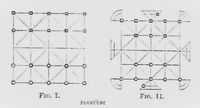
 This board was first documented by John Henry Hutton during his extensive documentation of the culture of the people in Nagaland. He stated that this was one game that the Angami Nagas played and this board had similarities with other forms of Alquerque boards played all across the world. He stated that the name Terhuchu meant fighting-eating which would make sense as the game was intended to fight and eat their opponent’s pieces. The board he explained is of sixteen squares joint by diagonal lines and this game is not always played on a board but on flat surfaces where the diagram of the board is sketched temporarily or even at times incised on the ground or on stone slabs. He further explained that the pieces were usually also bits of stones, moved obliquely or straight along the lines, one going the distance of one square only at a time unless they are able to eat one of their opponents by jumping over them into an empty station beyond. It is a two-player game with each player having ten pieces on their side but at times the pieces to be played with could also be eight instead of ten. Another variant is played with nine pieces on each side. The number of pieces changes the rules and the strategy of the game. According to Hutton, some form of gambling with cowries are also practised by the Angamis, one rule being that no gambler may refuse to go on staking unless the whole sum which they brought with them to the game is exhausted. This game was further documented by Murray, who also mentions the variants of the pieces being used in the game. The Digital Ludemi Project also records this game and mentions that this game has similar rules with Perali Kotuma from Sri Lanka.
-
 Shung Khama Chih Khi (Top Spinning)
 This game is played on the ground and according to sources, it is more popular amongst male players. It is competed amongst two groups. The top spins are made of wood and it is of round shape at both ends protruding with the middle portion wide. A cotton rope is tied to the top of the top spin for spinning it on the ground.
By hitting the topspin of the opponent, if it could stop the opponent’s topspin from spinning, one is declared the winner. But in case, the attempt fails, it indicates defeat. In this way all participants are given chance. And the winner will go to second round and after that points are calculated and the team which gets maximum points is declared the winner.
-
 Tarup Ar Merom (leopards and goats)
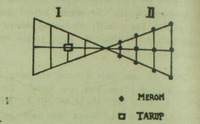
 This game was recorded in a text titled ‘Hoṛ Gidra Enec’ which documents seventy three different games played by the Santhals. The text is written in Roman and the language is Santhali so the exact rules of the game could not be translated. According to the Santhali dictionary, Tarup means leopard and merom means goats. The image of the game is given in the book which was digitised in The endangered archives programme by The British Library in the project titled 'Locating and digitising early Santali periodicals published between 1890 and 1975 in Eastern India (EAP1300)'. According to the diagram of the structure of the board it also finds similarities with other alquerque games like Lau Kata Kati.
-
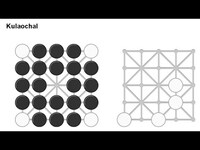 Kulaochal
 This game has been documented by D.N Majumdar in Jharkhand. It is a popular game played by the Ho community. This game as he explains through the structure of the board or the game pieces is similar and is another variant of Bagh Chal. He also mentions this to be similar to shola guti or sixteen pieces. According to him the game is played by drawing the board on the ground. A quadrilateral diagram is drawn with chalk on the ground. The diagonal is intersected by three equidistant parallel, lines drawn within it perpendicularly and three horizontally. Two lines are then drawn diagonally so as to intersect each other at the centre of the diagram. Finally the middle points of each of the sides of the quadrilateral are joined by four straight lines. A guti or a piece of the game is represented with the name of ‘kulao’ being tigers and ‘meroms’ being goats. As per the rule of this game there should be four kulaos and twenty meroms placed on the board. The pieces could be used in the form of local stones, or seeds or similar materials. The gutis are placed at each of the twenty points of junction of the three horizontal lines with the three perpendicular lines and with the four sides of the quadrilateral. Two players sit face to face on two sides of the drawn board.
-
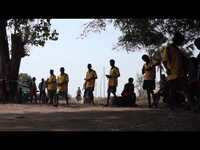 Sekkor or Sekar
 This game was documented by D. N. Majumdar as a game popular amongst the Mundas and Hos of Jharkhand. According to Majumdar Sekar means a top which is used to play the game. The game involves spinning the top using a string which is rounded and tied to the step of the top which is made to spin on its point by pressing it against the ground. This game is played on the ground and the players target the opposing team by topping the top on the ground. This game is also called the rain calling game and it is played by seven players in each team divided into teams of two.
According to another source, mythological source suggests this game was first played between two men and Devils and eventually the early men won. This game is played in peak summer and is believed to bring rain and prevent drought. Made of Kusum wood, the Sekkor, is shaped like a big top with an oval plane cap. A string is wound closely to a pointed base that enables it to be toppled over by the opposing team. This can suggest that there might be variants of the game or the rules might change.
-
 Haar'e
 Haar'e or Haaran Gindun is a game played with Kaudi or cowrie shells by Kashmiri Pandits during the festival of Shivaratri. The title or the name of this game comes from the word Haar which means in Kashmiri, the money or a playing object. It is considered an old game although the period of its origin remains unknown. As the name suggest the main component of the game is the material, in this case the Kaudi or shells and the number of participants mentioned could range from two players to more. The rules of the game are followed on the day of Salaam (the following day after Shivratri) and Dalip Langoo who is the source informant of the game mentions that it used to be popularly played in Srinagar during his childhood.
He also provides a detailed description of the game along with the terms used in Kashmiri. Haar is the Playing object, Chaakh is the measuring unit consists of four Haar’s, minimum of two Haars are required to start a game, Kunyi is the Combination of single Haar resulting the win, Pushraan Dabu means, to add a Haar on a particular number as decided, Juph Taaq is even and odd combinations: In this, odd numbers were to be won and even means to pass on the game to next the player adding a Haar to the rest of Haars on surface, Chaakan is the combination of Four results the win,Duchi means combination of Two results the win, Shartal means the betting, and Tichan means to strike with one Haar another one which is more popular amongst children. He mentions that there are various ways to play this game.
-
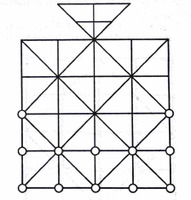 Bagh Chal (variant),Odisha
 This game was documented by Hem Chandra Das Gupta and the informant was from Orissa. He explains this game as a simpler version of Tiger Play, or a variant of Tiger and Goats where two players play this game, one representing the tiger and one representing the goats. It is played with one piece of tiger and twelve goats. The goats are all first placed at cross-points and then the usual game follows of Bagh Chal. Although the rule of how many goats are to be captured by the tiger before being trapped and out of moves is not mentioned in the essay.
He also states that this variant of Bagh Chal is similar and also a variant of another game called Kulaochal played by the Ho community in Kolhan and he draws this similarity from D.N Majumdar in his work on the games of Ho in Kolhan. He also mentions that although the similarities there are differences present in the two variants. He also compares this game with the game of Rimoe or Rimau in Indonesia. One major similarity between the two lies in the fact that before the beginning of the game, the player representing the goats is supposed to place all their pieces at cross-points. It is also noteworthy that the structure of this board is similar to that of Mughal Pathan or other alquerque boards of Bagh Chal.
-
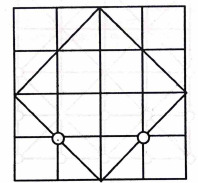 Bagha Chheli ( Odisha)
 This game has been recorded by Hem Chandra Das Gupta and the informant was from Odisha; it is also called Bagha Bajari. This is explained as another variant of Bagh Chal which is played popularly all across India. There are variants in Bhutan and this hunt game is popular in Nepal too. The variants of the structure of the boards vary, along with the number of pieces representing the goats and tigers but the intention of winning the game, remains the same in most cases.
Two players are necessary for playing this game, one in charge of the tigers and the other in charge of the goats. The tigers are 4 in number while the number of the goats is 20. Before the commencement of the game, the tigers are arranged at the places indicated in the figure by the circles and 4 goats are kept on any 4 cross-points according to the discretion of the player. The move begins with the man who has got the tigers, and the player who has the remaining 16 goats in his hand must place all of them on the cross-points one after another before he may move any goat on the diagram from one cross-point to another. The player with the tiger tries to capture as many goats as he can while the other player aims at checkmating his opponent.