-
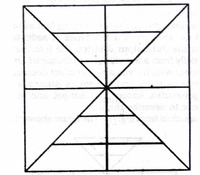 Dash Guti
 This game was recorded by Hem Chandra Das Gupta and the information was collected during one of his field visits to Gosalpur in the district of Jubulpur, in present Madhya Pradesh
-
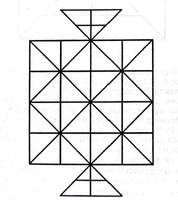 Atharagutiala Teora
 This game was recorded by Hem Chandra Das Gupta and the information was collected during one of his field visits to Gosalpur in the district of Jabalpur, in present Madhya Pradesh. He mentions in his essay that the play pattern of this game is similar to Bara-Guti which he documented in Bihar. The difference lies in the structure of the board.
-
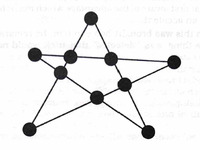 Kowwa Dand
 This is another game recorded by E. De. M. Humphries in Karwi, a district in Uttar Pradesh a kind of “Solitaire,” known as “Kowwa Dand.” As written by Humphries he had difficulty recording the rules of this game, as the man who showed him the diagram had forgotten them, and the only man in the village who knew the game at all, had not played it for years.
-
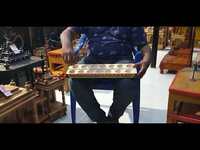 Gud Phale
 Gud Phale or Ghuu'ddh Fha'le'h commonly known among the elders was a popularly played games. In Goa, India these games are made by the people of Chitari community and comes with colorful designs on them. The game is played with two players usually with the food grains in the groove (Ghuu'ddh). This is another possible variant of Mancala, Pallankuzhi, Vamana Guntulu, Morkor Katiya and many others played all across India.
-
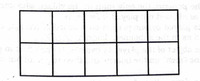 Pachgharwa (five spaces/homes)
 This game has been recorded by E. De. M. Humphries in Karwi, a district in Uttar Pradesh. This game has many variants although the number of ghar(square/home) differs from region to region. At times variants are also played with holes dug in the ground. There are also variants where a wooden board of circular holes are used. The basic intention or play pattern remains similar with changes in strategies or terminologies used while playing the game. In this particular variant it is played on five squares respectively as shown in the image. It is a two-player game who take opposite sides of a board of ten spaces, arranged and is played by using five pieces in each square.
-
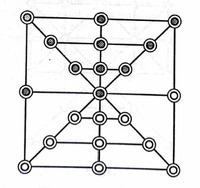 Kowwu Dunki - A Variant of Ahtarah Gutti ( Eighteen Pieces)
 This game along with another variant was recorded by E. De. M. Humphries in Karwi, a district in Uttar Pradesh. He mentions that these variants have the same rules as another game recorded by him and mentioned in the same essay, known as Ahtarah Gutti ( Eighteen Pieces). The only information we get on these variants is the changes in the shapes of their boards and the second board shown in the second image was played in Bargarh when he recorded these. These variants are important to understand how a board can change the strageties of a game. One major difference is that due to the changes on the board, Kowwu Dunki is played on a board of 21 spaces, instead of 37 spaces which changes the play pattern.
-
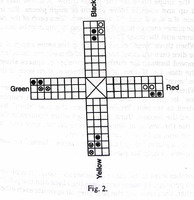 Chonpa- A Variant of Pachisi
 This variant of Pachisi has been recorded by by E. De. M. Humphries in Karwi, a district in Uttar Pradesh. It is known as Chonpa or Chaunsarh. According to Humphries, Another variant is known as “Chonpa” or “Chaunsarh.” It is a four player game, each having four “men,” coloured respectively black, yellow, green and red as shown in the image. The two former play in partnership against the two latter colours. The board is the same as a Pachisi board with the exception that the safe squares mentioned in the case of pachisi are either not marked at all or are disregarded, if the board is one made for both games. A single piece may, and a pair may not, be captured on any square to which a hostile piece may be moved. The moves are regulated by throwing three dice: not, as in the case of Pachisi, —cowries. These dice as documented were of bone or ivory and are about 2% inches long, marked on their long sides with the numbers (1), (2), (5) and (6).
-
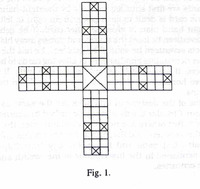 Pachisi
 The information on Pachisi has been recorded by E. De. M. Humphries in Karwi, a district in Uttar Pradesh. He writes in his essay that in the common meeting space of the village lay this board as shown in the image on a stone bench. In 1904 he attempted to gather the rules of the game.
Every arm of the cross is made into three rows consisting of eight squares. Among these, the fifth square from the end of each outer row and the center square of the bottom row are highlighted with a diagonal cross to show that a piece on either of these squares is protected from being captured. The game is played with four players, but can also be played with two or three participants, each having four “men” identified by their colours or pieces. Every player positions himself facing one arm of the cross, aiming to start at the center of the board and travel down the center and up the left-hand row of his respective arm, moving his four pieces around the board, eventually guiding them down the right-hand side and up the center row of his arm to land them in the triangular area at the center.