-
 Kolokpa
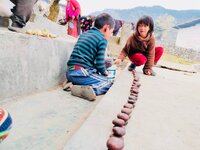
 Kolokpa (ཀོ་ལོག་པ) is a game long played by Bhutanese, amongst cow herders to pass their time while their animals graze. Kolokpa refers to the dry round seed extracted from the pod of a wild creeping plant (African dream herb Entada rheedii); these are collected and used to play the game, thus giving it its name. It is an indigenous game passed on from generation to generation through its play practices and according to sources, the game is also played in the winter seasons as it is the end of fruitful tiring journey of the year of cultivation to the villagers and people do not have other activities on their fields. It is even played by lay monks (gomchen) to pass their free time in the intervals between festival rituals.
This game can be played by any number of people (more than two) but it can only be played in even numbers like, two, four, six, eight and ten. There is also betting or gambling involved in the game.
The Kolokpa game requires a number of dry round seeds, enough to constitute a stack. The number of stacked kolokpa seeds depends on the players; the larger the stack, the longer the game. Each player or team puts their stack of seeds on the ground in a straight line.
The game begins by spinning a kolokpa seed on the ground, with the aim of hitting and disrupting the other team’s stack of seeds. The distance between the kolokpa seed and its target is usually between three and four meters. The spinning kolokpa must touch or hit as many of the opponent’s seeds as possible. Any of the opponent’s seeds that are disrupted or moved are taken by the shooter and added to his stack. The one who has the most seeds at the end is the winner.
A Kolokpa seed can also be used in musical instrument today as a yangkali, which can produce amazing rhythm sounds by vigorously shaking the pod. Once dried, the seeds have a hard shell.
Kolok-pa game does not differentiate between gender and age of the player, but teams are selected usually depending on the gender. According to 65 years old Meme Ugyen Guru, the game in the past can be played by burning bamboos and pinewoods for lighting the ground in the evenings. Mostly the betting is done for winning Bangchang, Ara (Local wine), pork and other food and drinks. The winner of the match is declared based on mutual understanding made within the players, and the bet is to be paid either after every game or out of three sets.
-
 Digor
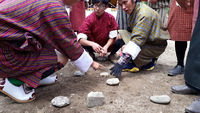
Digor Digor (degor) is a traditional game played in Bhutan, which is often mistakenly described by foreign authors as a type of shot put. There are many elements that make it different from the shot put game (including the way of throwing). It is played with a pair of round flat stones, which are thrown in the direction of two wooden targets placed on the ground roughly 20 meters apart. It is a traditional target-based sport of Bhutan, which has some similarities to boules or petanque. This sport is traditionally played by village men all around Bhutan. The game is slightly different in various regions. Organized games between neighbouring villages are now rare. Today the game is played for social reasons, mostly at annual religious festivals. Sometimes it involves a bet that concerns the organization of the event, where the loser must engage in its preparation to a large extent, while the winner has fewer tasks to do. This type of betting takes place among local communities or among friends.
-
Gyalpo Tanor
The game is a string game of trickily moving the bamboo pieces hung on the string. It is played in the district of Tashigang in eastern Bhutan. String are attached to a bamboo pieces with two holes in the centre. Two loops are created with two bamboo pieces hung on it. The trick is to move the two bamboo pieces on the same loop. A king and a clever man is said to have had a contest to do the trick, keeping a horse as a bet. The intelligent man is said to have succeeded in trickily moving the bamboo pieces from one point to the other and won the horse. As the king lost the horse, the game is know as gyalpo tashor, or the king losing a horse.
-
 Aek-drupa
 This is a throwing game where five pebbles need to be thrown and caught by the player in succession. In the video,Tshokey Lhamo and her friend from Radhi Gewog, Tashigang, demonstrate game called Aek-drupa with Pebbles. This game is also known to be common in India and Nepal as well.
-
 Ramayana Ganjapa from Sonepur
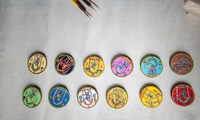
 The images here showcase Ramayana Ganjifa or Ganjapa by Satyanarayan Maharana of Ghoraghatpura, one of the last remaining artists of Sonepur Ganjifa cards at Odisha. His family has been involved in making Ganjifa cards for generations and he has learnt the art from his father. His wife, Umavati Maharana is also an artist who makes Ganjifa cards. They are additionally artists who make patachitra paintings as well. Ganjifa cards are hand painted cards made out of cotton cloth, tamarind seed powder and khari mati (chalky soil). After the base of the cards are prepared, they are painted. While there are variants like Navagunjara, Ashtamala, Satyanarayan Maharana mainly makes Ramayana painted Ganjapa cards.
Satyanarayan Maharana mainly makes Ramayana painted Ganjapa cards. Ramayana painted Ganjapa cards consists of a set of 144 cards, comprising of 12 suits, with 12 cards in each suit and requires 4 players. Ram has 6 suits namely, Ram, Lakshman, Makar (team of monkey), Bhalu (jambuban), Parvat and Bibhishan. Ravana’s team also comprises of 6 suits namely, Ravana, Kunt, Katari,Sul, Pasho and Khanda. Every suit has a king card, a vizier card, an Ace and numbered cards from 2 to 10, 2 being highest and 10 being lowest. The numbered cards have unique symbols drawn on them and the number of symbols drawn signifies the number of the card. While playing, once the cards are randomly distributed, the player who receives the Ram card and the player sitting opposite to him belongs to the Ram lobby, making the other two players part of Ravana’s lobby.
-
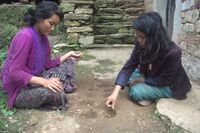 Düzalé
 This is a mancala variant showing 4 holes facing each other and one hole at the end.
-
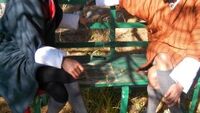 Taag dha Nor or Tagnor (Tiger and Cow)
 Tagnor is a traditional Bhutanese board game, where a board with lines are filled with pellets representing cattle and two large tokens representation tigers. As the players makes a move, the tigers find opportunities to kill the cattle by jumping over the pellets. If the tigers cannot move as a result of shrewd moves from the cattle like, the cattle wins but if the tiger kills a specific number of cattle before they can cut down his movement, the tiger would end up winning. The game can be played with minimal preparation by drawing the board lines on any surface. In this the board is etched or incised on what looks like a park bench and is been played with local seeds by two players. In other cases there are also boards available made of cloth, wood and many other materials.
This game is a variant of the played Bagh Chal which is popular in many parts of India and is also the national game of Nepal.
-
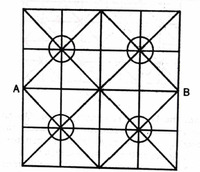 Bagh Chal, Kamakhya
 The game of Bagh Chal, popular by several other regional variants and alternate names has also been documented in the Kamakhya temple region of Assam by Jatindra Mohan Datta. He mentions recording this game from two boys of Nepali descent who were seen playing the game at that time. The location of the board as per his observation in 1939 was on the western side of the temple complex a few yards away from the stone wall built by Narak Asura. This board was engraved and the boys were seen playing this with 2 tigers and 20 pieces of goats.